
Dispatch: Photographing with Respect
Words & Images by Chris Peirce, ACLC Environmental Storytelling Intern
ACLC Environmental Storytelling Intern Chris Peirce spent a night in a remote location to photograph loons and chicks.
When a loon biologist gives you an inside tip on the best places to photograph loon chicks, you take his advice, even when getting there is an expedition.
"It's a great place to get photos of some older loon chicks but it's a little far to get there," is what Griffin Archambault said when he shared his secret loon location. I chose a Saturday evening to start, setting off at a later hour than I intended, and after most of the weekend canoe traffic had departed. Four miles of paddling and two carries seemed like a modest and entirely doable evening trip. However, as I passed campsite after campsite, each already occupied, I began to realize that I would be paddling later into the night than I anticipated.
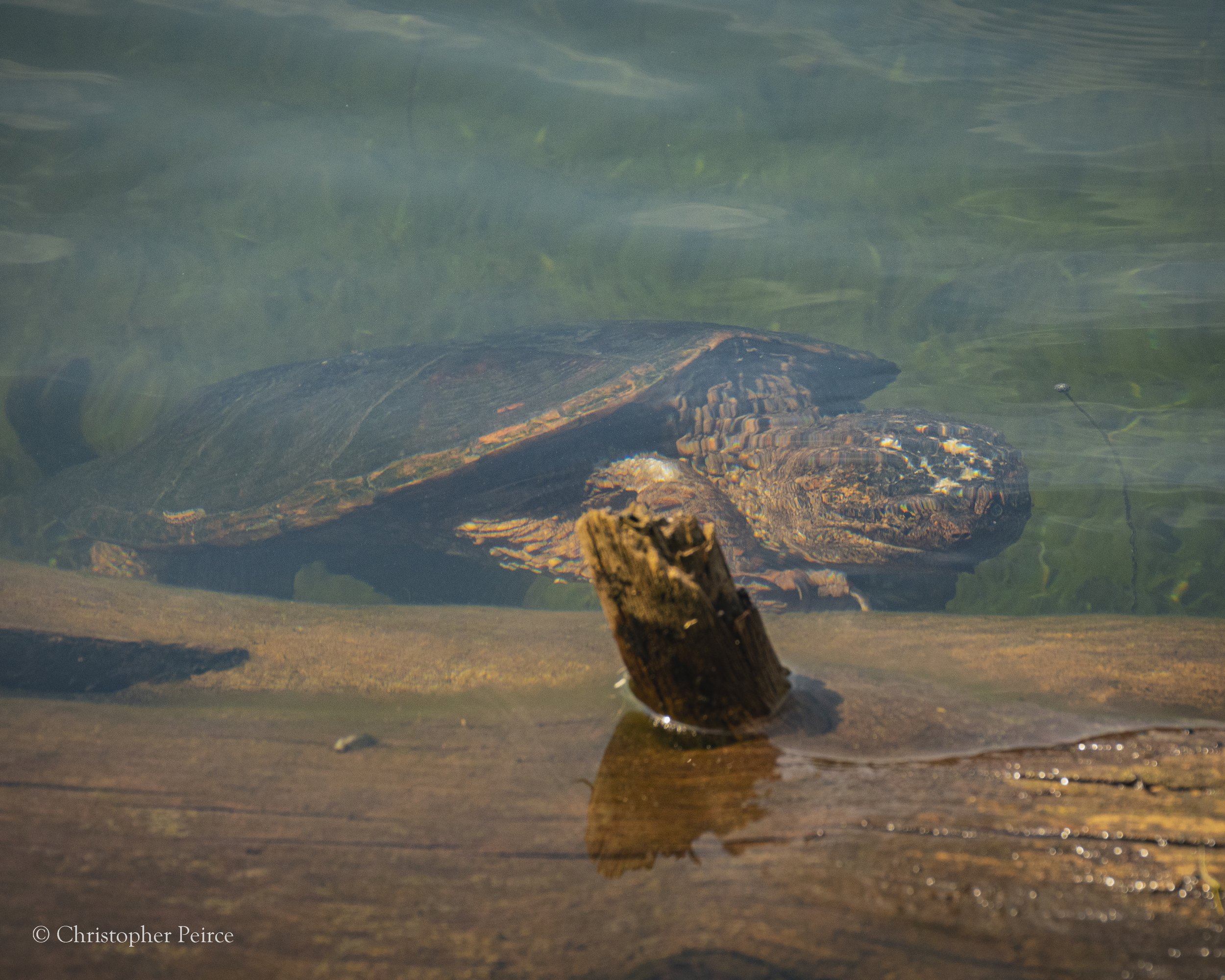
A raccoon in the night and large common snapping turtle under the surface are a few of the animals Chris Peirce encountered on his trip to photograph loons and chicks.
When I finally found an unoccupied site near my target location, it was 10 pm and quite dark. I spotted the site marker via headlamp, unpacked my boat, strung my hammock, and kindled a small fire. Throughout the night from my hammock, I could hear the loons calling back and forth between lakes, their haunting voices echoing both close and far in the distance. Around 2 am I awoke to footsteps in and around the campsite. They were too large to be a squirrel and far too small to be a bear, but I had bagged and hung up my food appropriately, so I wasn't overly concerned. Still, I spoke loudly into the darkness, hoping to send the culprit packing. Each time the scurry of feet faded into the trees, only to return five or ten minutes later. The third time I quietly slid out of the hammock and caught the culprit in the act. My headlamp illuminated the innocent face and grasping little hands of a raccoon, sitting below my food bag and trying to work out how he might pull off a midnight burglary. This time, when I chased him back into the trees, he did not return.
The next morning, rising with the sun, I packed up camp and returned to the water, excited to see the loons in the light of the sunrise. The pond was small, so small in fact that I wondered how it provided enough territory to sustain a loon family for the summer. As is common with remote pairs, the loons were more reactive than those living on populated lakes. The lack of boat traffic meant they were less acclimated to human presence and had no interest in allowing me the opportunity to photograph. Despite the small size of the pond, it was challenging to get near enough, even with a telephoto lens, to make good pictures.
It's impossible to truly know what's going through an animal's head while making pictures. For me, there's a continual litany of worry over how my actions are impacting their stress levels, behavior, and movements. An animal can't consent to interaction in the same way a person can. They can't communicate their stress and anxiety at someone's presence in plain, simple language. In the natural world, I've found that the best photos usually happen from a philosophy of surrender. The land, water, and wildlife don't care about my reasons for being out there. They aren't interested in being subjects in the stories I'm trying to tell, and they don't recognize or understand my mission as a photographer. They exist within the cycle of the day and season, and they move and react based on their own instincts. Observing them respectfully requires me to bend to that cycle.
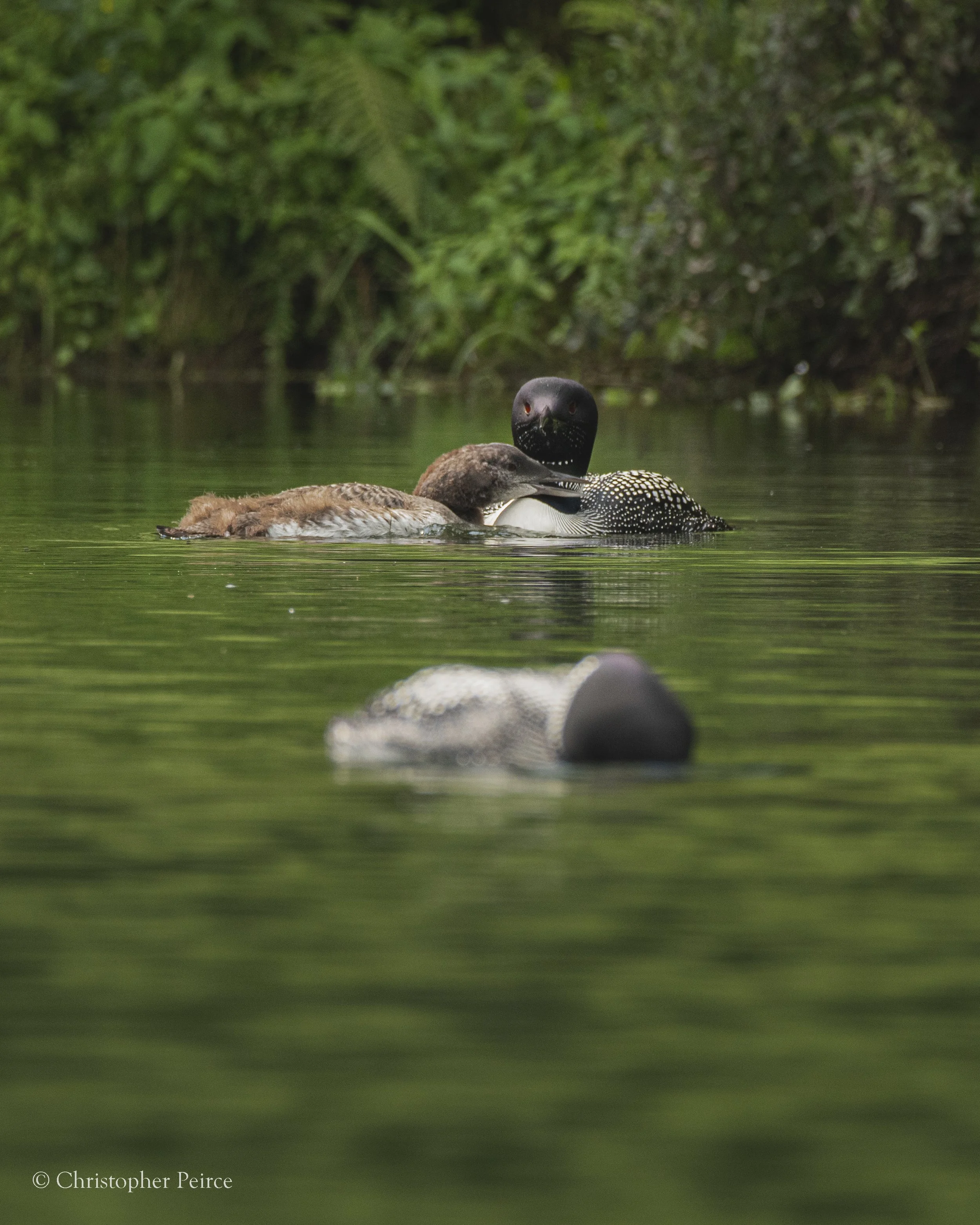
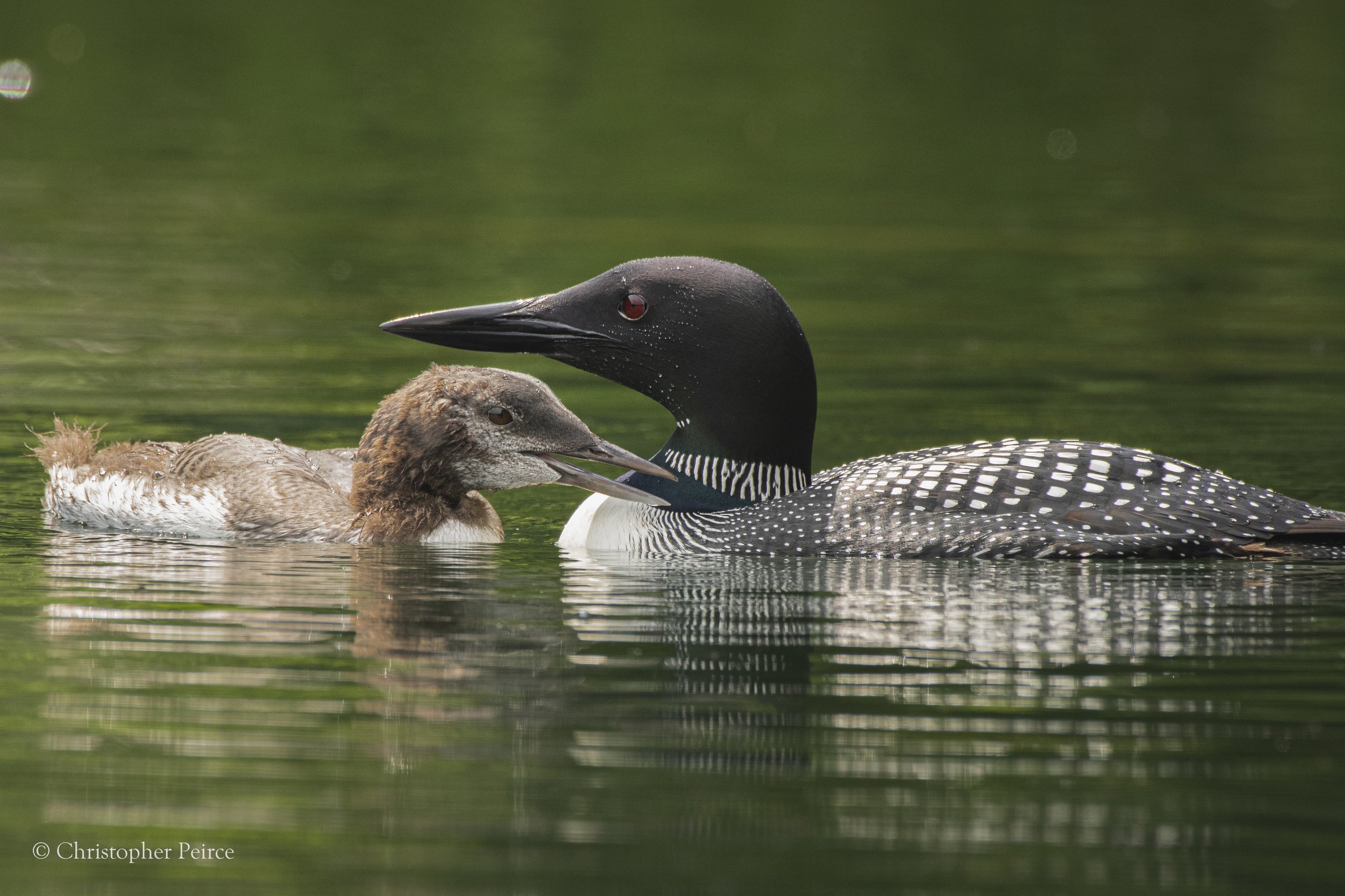
While one parent searches for food, the loon chick begs from its other parent.
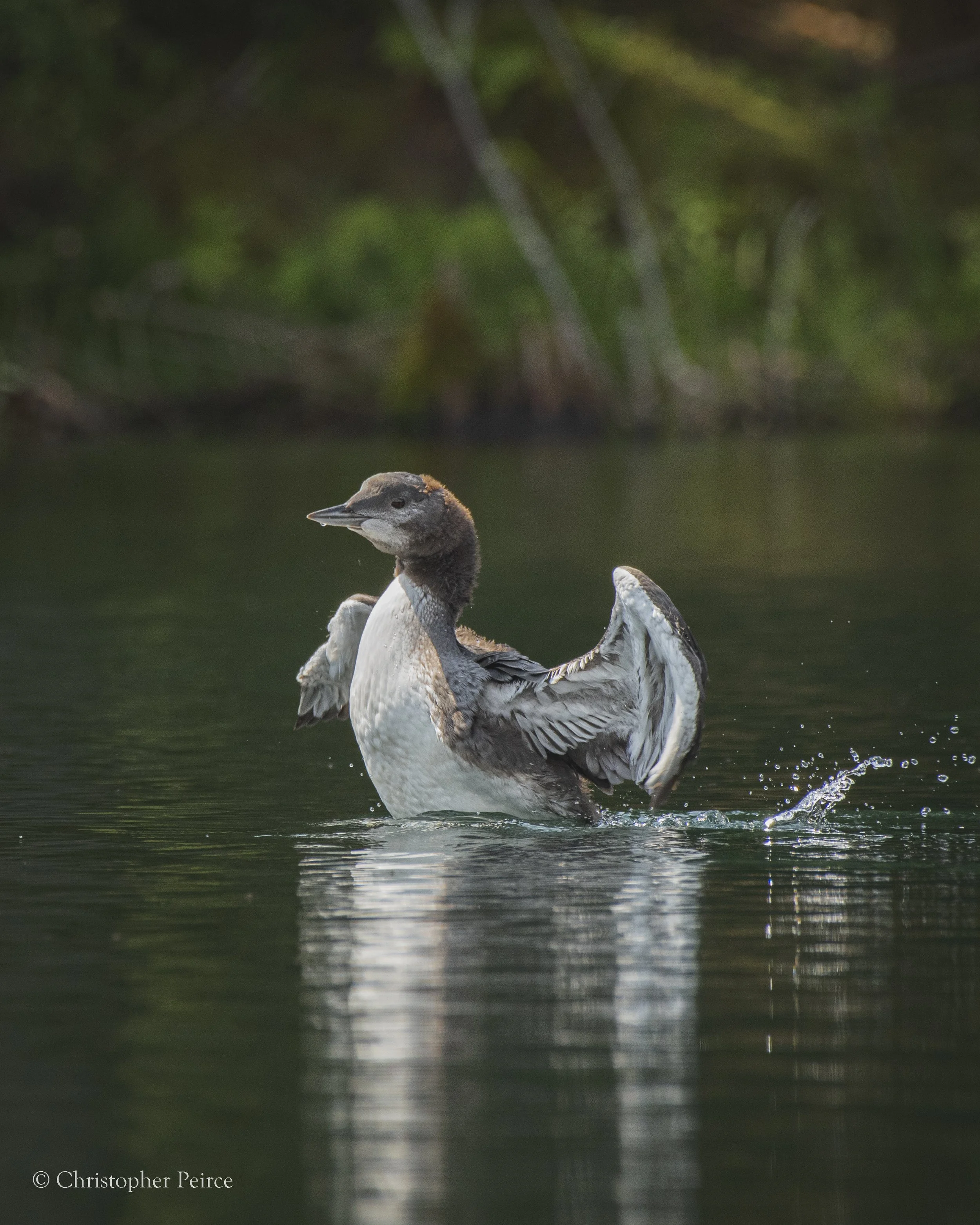
The loon chick stretches its wings.
As the sun climbed higher, I realized more patience than usual would be required. I stopped trying to approach. Floating near the end of a small peninsula I waited, watching as the loons moved around the pond, teaching their chicks to fish. I worked to slow my movements, not raising the camera, and not repositioning the canoe. A gentle breeze moved the water, and I allowed the boat to drift. Any motion, it seemed to me, should be as natural as possible, and as unhurried as I could make it. Deer flies repeatedly landed on and bit my legs and feet, climbing under the straps of my sandals, testing my commitment to stillness.
The hope was that the loons with their keen eyesight would begin to see me, not as a foreign visitor, but as an organic and normal part of the pond, unthreatening to their lives and uninterested in their routines. After nearly two full hours of sitting, the canoe had drifted to the opposite shore. When a snapping turtle nearly the size of my torso surfaced within arm's reach, seemingly unbothered by my presence, I decided that patience had finally granted me some degree of unobtrusiveness. Anticipating the path of the fishing loon family, a few gentle paddle strokes positioned me in an excellent vantage point. I held my breath as the loons approached, then I began to photograph.
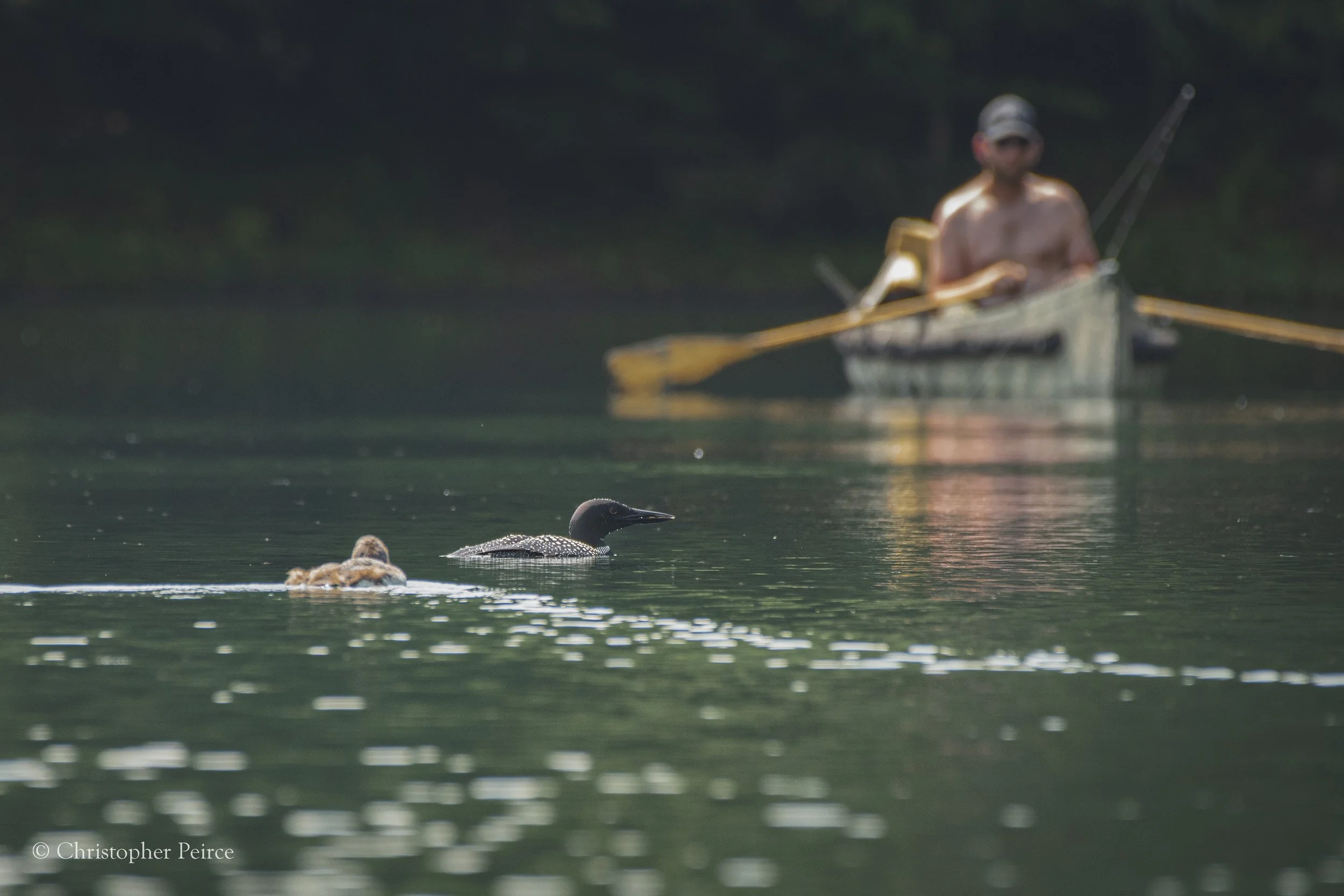
An angler is of little concern to the loon family so long as he moves slowly and keeps his distance.
Although certainly aware of my presence, the loons continued to interact and move as normal. The chicks pretended to fish while waiting for their parents to return with food. They napped on the water, quietly floating, sometimes waking up to preen and stretch their wings. When a man with a small fishing canoe arrived, there was momentary concern from the loons, but for the most part, he moved slowly and kept his distance. I continued to observe. Of their own free will the loons began to come closer, naturally curious now that I had shown I wasn't a threat.
I was so intent on the loons and their behavior that I barely registered the sound of paddles and the splash of water from the nearby carry trail. When I looked up, two people paddling light solo boats were moving swiftly in my direction, clearly trying to cover the distance as efficiently as possible. It was too late to call out to them as I realized that the loons were right between these boats and the next carry trail. The loons and their chicks dove, disappearing under the water. Several minutes later they resurfaced several hundred yards away. The two paddlers had disappeared up the carry trail. From the loons' body language could tell that they were on high alert and were unlikely to let me approach again. Across the pond, more paddlers entered the water, and I realized my quiet morning with the loons had come to an end.