
Words & Images by Denise Silfee, ACLC Director of Programs and Communications
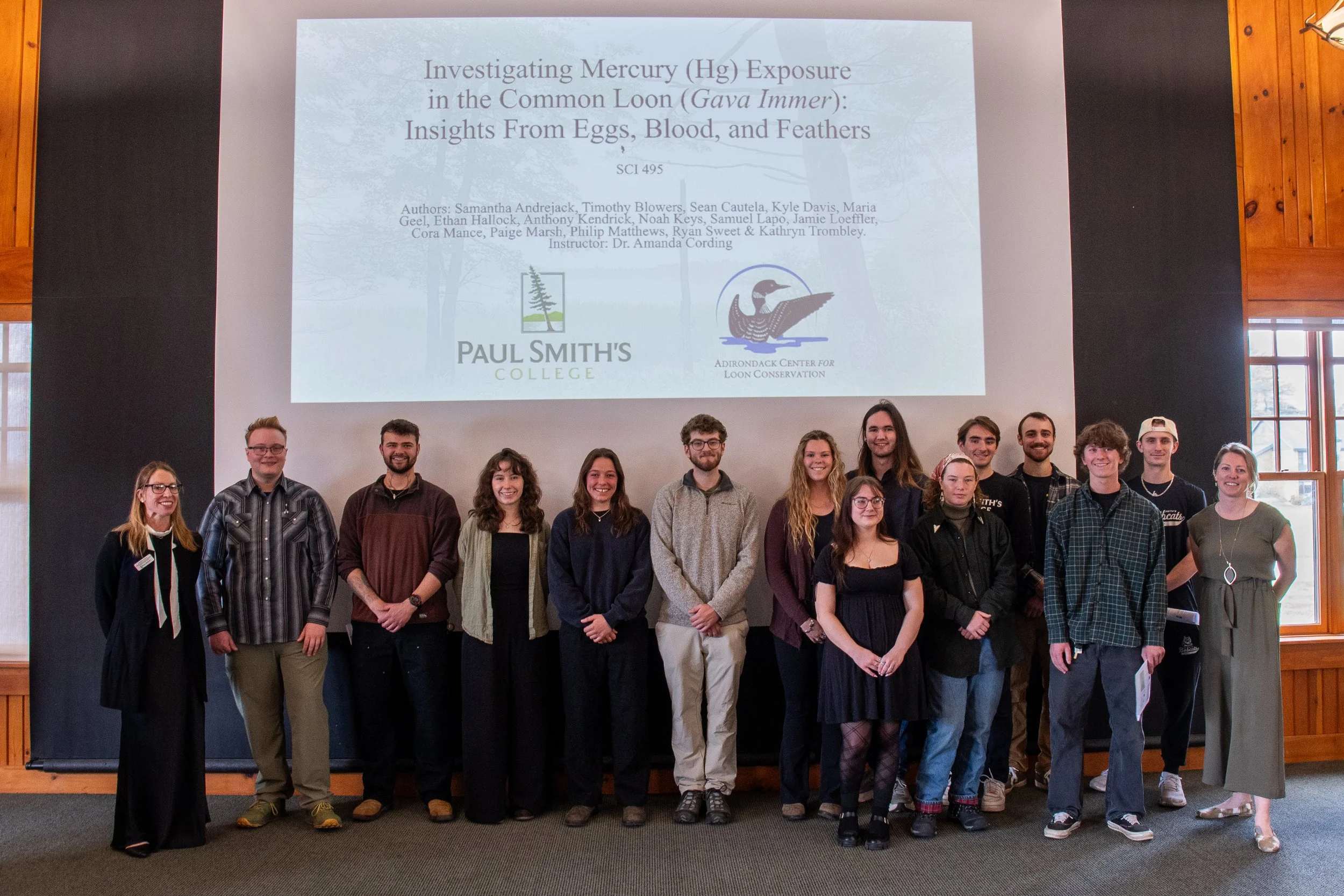
Students in Dr. Amanda Cording’s Environmental Science Senior Capstone class at Paul Smith’s College, pictured with Dr. Cording (far left) and Dr. Lizz Schuyler (far right) presented their project to the public on May 1, 2026. The students authored a paper after analyzing data provided by the Loon Center that they plan to publish. Student authors are: Samantha Andrejack, Timothy Blowers, Sean Cautela, Kyle Davis, Maria Geel, Ethan Hallock, Anthony Kendrick, Noah Keys, Samuel Lapo, Jamie Loeffler, Cora Mance, Paige Marsh, Philip Matthews, Ryan Sweet and Kathryn Trombley.
This spring, students in Dr. Amanda Cording’s Environmental Science Senior Capstone class and Dr. Lizz Schuyler’s Wildlife Management class presented to members of the public at Paul Smith’s College. Several Adirondack Center for Loon Conservation (ACLC) staff members were present to listen, because the students were presenting their findings on data provided by the Loon Center.
When Dr. Schuyler joined the staff of ACLC as the new Senior Director of Science and Conservation in January 2026, she was still teaching a class at Paul Smith’s. This dual role provided a natural opportunity for partnership between the Loon Center and Paul Smith’s College.
“From the moment I stepped into this dual role, the partnership between Paul Smith’s College and ACLC felt completely natural,” said Dr. Schuyler. “The Loon Center has invested years of effort into collecting high-quality data, but we’ve historically had far less capacity to fully analyze it. Bringing that real-world data into the classroom gives students an authentic research experience while also helping us answer conservation questions that matter on the ground. Both ACLC and Paul Smith’s are deeply rooted in the Adirondacks, so it’s incredibly rewarding to see our collaboration not only advance science but also make a tangible conservation impact right here in the park.”
Dr. Cording’s senior capstone class was provided with mercury data from 853 loon egg, blood and feather samples collected by ACLC researchers between 1998-2024. The thirteen students in the course worked collaboratively to analyze the data and figure out if there was anything statistically significant to say about it.
And to their excitement, there was – they plan to publish their findings later this year.
The students delivered their presentation, titled “Investigating Mercury (Hg) Exposure in the Common Loon (Gava immer): Insights from Egg, Blood and Feathers” to over 100 people on May 1 in the Pine Room on the Paul Smiths campus.
Jamie Loeffler, who majored in environmental biology, enjoyed the experience of working with her peers on something relevant in the real world. “I was excited about this project,” she said after the presentation. “It was really cool how things we had learned in the literature were consistent with what we found.”
Some of the consistent findings students pulled from the data include the fact that male loons continue to have higher levels of mercury in their samples than females, which can impact their ability to provision food, defend their territories and reproduce successfully. Samples also consistently presented more mercury stored in feathers than in blood, with samples from eggs containing the lowest levels.
The big finding, however, was that among 19 watersheds where there are ten or more years of data and at least eight samples, most samples showed that mercury levels appear to be increasing over time.
Jamie Loeffler, environmental biology major, and member of Dr. Amanda Cording’s senior capstone class.
Maria Geel, environmental biology major, and member of Dr. Amanda Cording’s senior capstone class.
Sam Lapo, environmental science major, and member of Dr. Amanda Cording’s senior capstone class.
The reasons why are unknown, but Dr. Cording plans to continue looking into these hotspots where mercury samples are high and where it seems to be increasing with a new class of students this fall. “If there are higher concentrations in some areas, why is that? I’ve talked to the Fish and Wildlife faculty about fish tissue sampling and looked into doing a sediment core to see how deep the mercury appears in the soil. If we can look at all of this together – tissue samples from fish, soil, loons – we can ask, where is the majority of mercury coming from beyond knowing it comes from sources like power plants, but which age? Can we see how long this is going to be in the system? Is this a decades problem or a hundred years problem?”
Students also learned about mercury generally, perhaps in ways they hadn’t understood it before.
“I found it interesting learning about how it was the industrial revolution that produced a lot of this mercury,” said Jamie. “[The U.S.] started passing legislation that decreased it, but the mercury is still increasing. Even though the emissions have decreased, it’s still staying in the population as a legacy contaminant.”
Student Maria Geel, also an environmental biology major, agreed: “I expected there to be the presence of mercury. I think we all know that’s an ongoing issue. I was definitely shocked, though, with how strong that ending data was. I didn’t expect that the majority of our watersheds were above the EC20 levels – meaning that more than 20 percent of individual loons are affected. That’s kind of crazy. That allows a lot more suggested future study and we have a lot of places to go with it now. I think it also shows how important it was to do stuff like this because we didn’t know the levels were this exaggerated.”
Students in Dr. Schuyler’s wildlife management class also delivered presentations that afternoon using camera trap data sets related to loon nesting success. Adia Hermann presented “Air Temperature and Loon Nesting Success;” Makayla Vigneaux and Jeremiah Harrington presented “Comparison of Nest Failure and Disturbance for Adirondack Common Loons Using Camera Trap Data;” and Emily Duda and Sabine Cowen presented “Terrain Matters: Topographic Predictors of Loon Nest Success.”
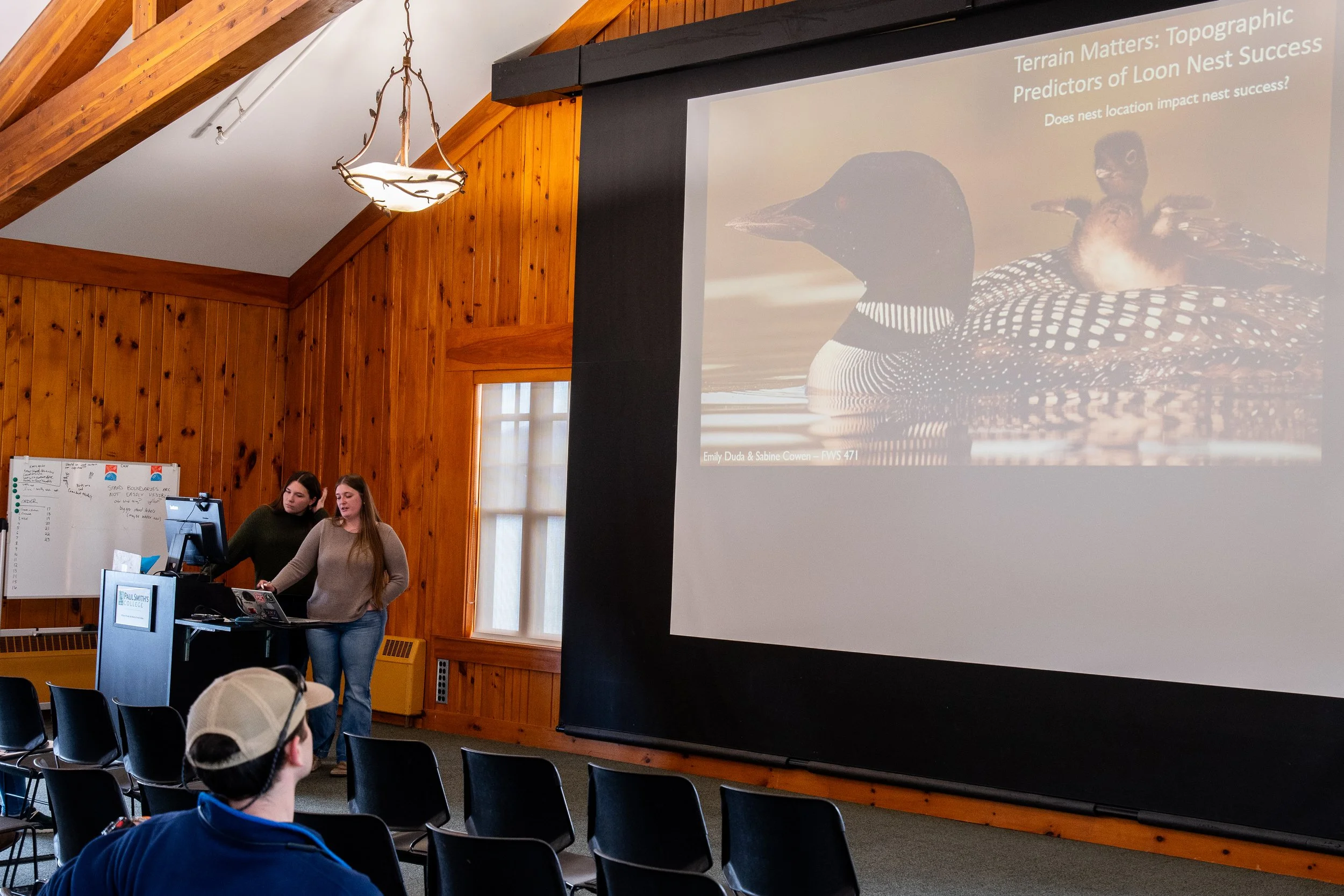
Emily Duda and Sabine Cowen presenting their research.
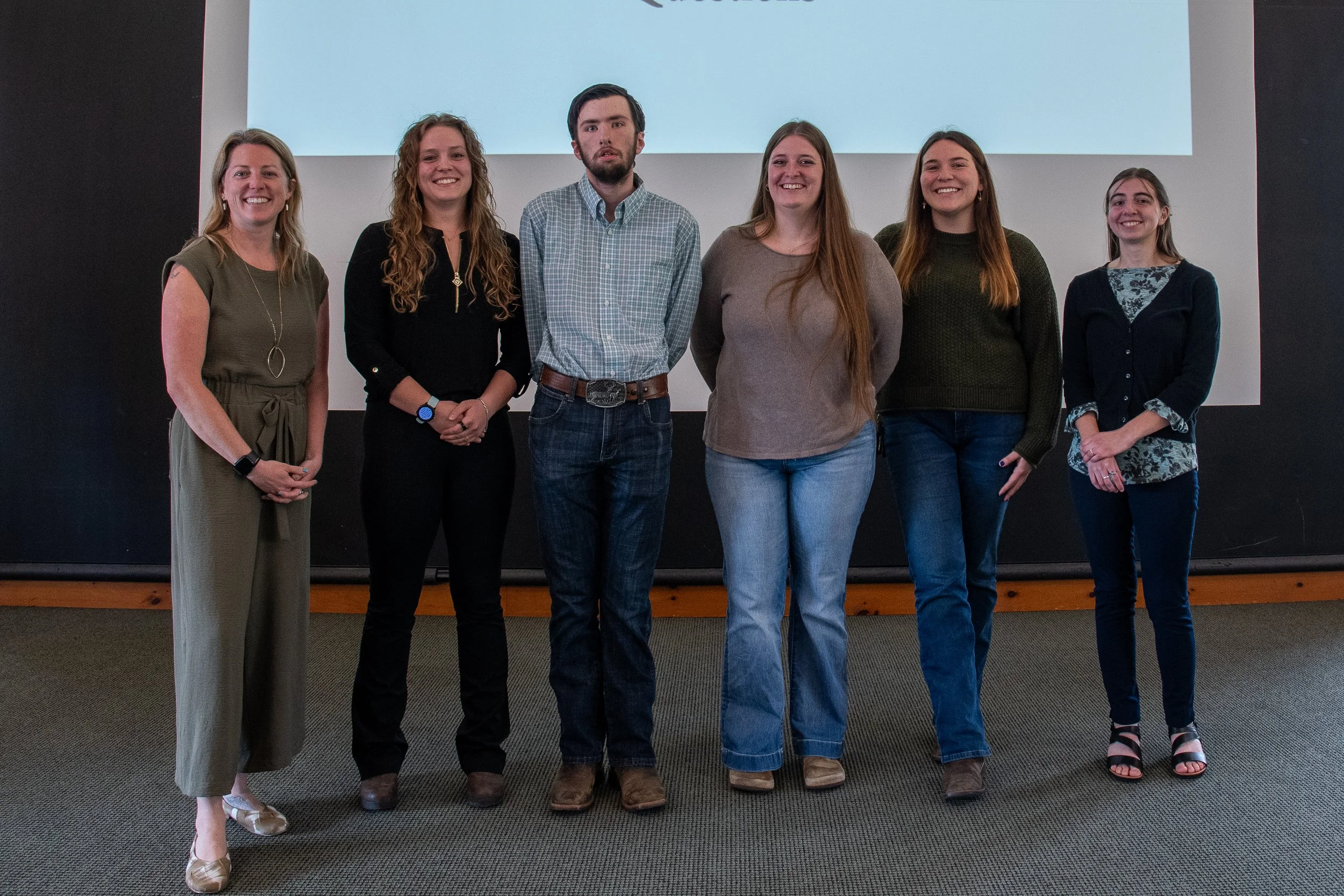
Dr. Lizz Schuyler (left), ACLC Director of Science and Conservation, with students from her class (left to right): Makayla Vigneaux, Jeremiah Harrington, Emily Duda, Sabine Cowen and Adia Hermann.
All three presentations found that the data was not statistically significant enough to draw a strong conclusion, but they made suggestions for how to narrow the parameters to answer questions about loon nesting success related to temperature, disturbance and topography in the future.
Jeremiah Harrington, a fisheries and wildlife science major, felt that the experience of working with data from the Loon Center was beneficial because it gave him a deeper sense of the variety of data quality he might encounter in the real world of research. “It was eye opening to see just how difficult it is to get a statistically significant result right away.”
Because the data came from nest cameras that capture loon behaviors when people aren’t around, Jeremiah also found it informative to “see just how often loons are disturbed by tourists and the lasting impacts we have on them after we put our cameras down and paddle away.”
Dr. Schuyler was thrilled to invite students to help sort through the camera trap data. “The camera trap images were a completely opportunistic dataset – 13 years of footage from 154 loon nests that collected without a specific study design or hypothesis in mind. No one had really been able to do anything with it yet, but that doesn’t mean it isn’t valuable.”
Even though the camera trap footage was, as Dr. Schuyler puts it, “kind of messy,” she said it’s “exactly the kind of messy, real-world dataset that students are likely to encounter in their careers. Having them dig into it, identify patterns, and grapple with what the data can and can’t tell us is an incredibly powerful learning experience. Even without statistically significant results, they were able to highlight key knowledge gaps and propose focused questions for future research.
“For the Loon Center,” Dr. Schuyler continued, “this feels like a powerful new direction, leveraging our long-term monitoring to generate hypotheses and guide more targeted studies. It makes me genuinely excited for the future of our science program and the many ways we can keep working with Paul Smith’s students to protect loons across the Adirondack Park.”
Sam Lapo, an environmental science major who was in Dr. Cording’s class, agreed about the benefits of the partnership: “I absolutely think this partnership is important because it shows that what we’re learning here is applicable in the real world. [...] We’re going into a job market that’s not the greatest but just seeing that there are organizations that are willing to work with the college in this local region as a community partner is fantastic.”
The Loon Center will be excited to share a link to Dr. Cording’s students’ published paper once it becomes available.