
Dreaming of Loons: A Summer on the Big Lake
Words & Images by Izzie McGinley Myers, ACLC Seasonal Field Biologist
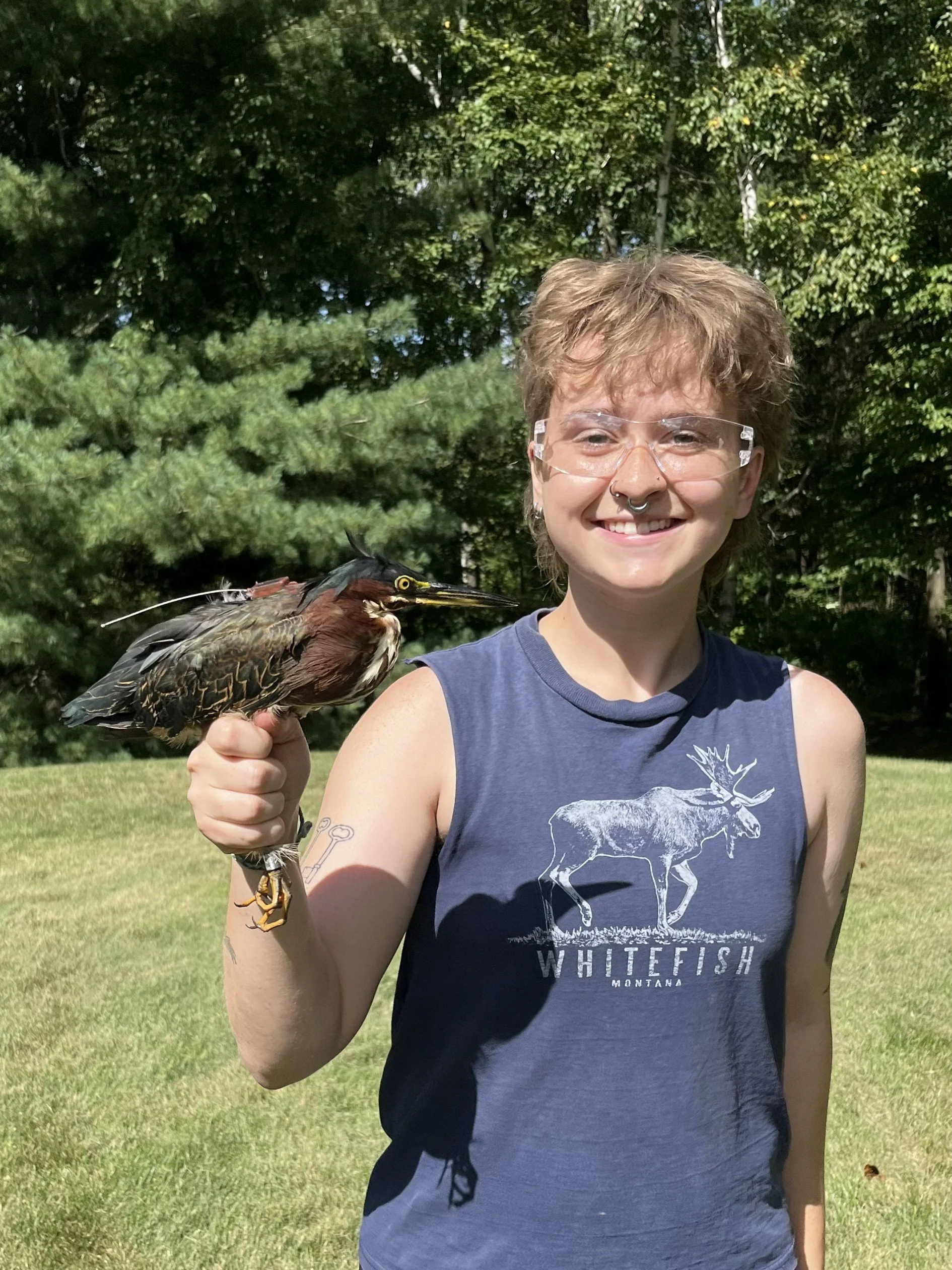
Izzie McGinley Myers feels lucky that she has always known what she wants to do: work with wildlife. She spent a summer as a seasonal field biologist for ACLC. She is pictured here with a green heron while working on a green heron migration project.
As the summer field season has been coming to a close, I’ve been reflecting on my experiences as a seasonal field biologist with the Adirondack Center for Conservation (ACLC). The defining trait of my summer is how closely I have lived alongside nature. My cabin on the SUNY ESF campus in Newcomb is on a lake in the woods, the backyard is covered in moss and wildflowers, and it has no street address or wifi.
I graduated in May of this year with my bachelor of science in fisheries, wildlife, and conservation biology from the University of Minnesota, with an emphasis on wildlife. I spent my childhood catching snakes and frogs at every chance, putting caterpillars in my pocket at recess, and researching my pet crested gecko. In first grade we had an assignment to draw our dream job, and mine was a picture of me taking a bird out of a net, titled “animal rescuer.” Last summer I worked under Dr. Elena West at UMN mist netting green herons; my childhood dream had already come true!
This past February, when interviewed for this position with ACLC, I was asked if I would be comfortable paddling all day on remote lakes with no cell service. “It sounds perfect,” I had said.
When I leave for work before sunrise, I marvel at the different colors and shapes of moths that have collected around the porch light. All the lakes I monitor except one are paddle-only, and none have cell reception except for occasional spots in the middle of the lake. Other than dozens of loons, I’ve seen snowshoe hares, river otters, mink, bats, deer, over 100 bird species and three black bears during my workdays. In total, I monitor 11 lakes containing 24 distinct loon territories. I love all my lakes, but one of them takes up most of my effort. I’ll call it the “Big Lake.”
The Big Lake is a paddle-only lake, one of the larger lakes ACLC monitors for nesting loons. From where I put my boat in, it’s about a five mile paddle one way across the lake. I survey the lake over the course of two days, camping overnight. I’m circling islands and bogs, checking bays and inlets looking for loons and nests, following loons around hoping for a glimpse at leg bands. An average day on the Big Lake is 10-15 miles of paddling, and an entire trip is often over 30 miles. I once paddled 23 miles in one day! On the longest and hardest days, it feels like I’m really accomplishing something. When I found my first chick, in the farthest possible territory from the boat launch, it felt like a huge reward that I couldn’t have achieved from a short paddle. ‘
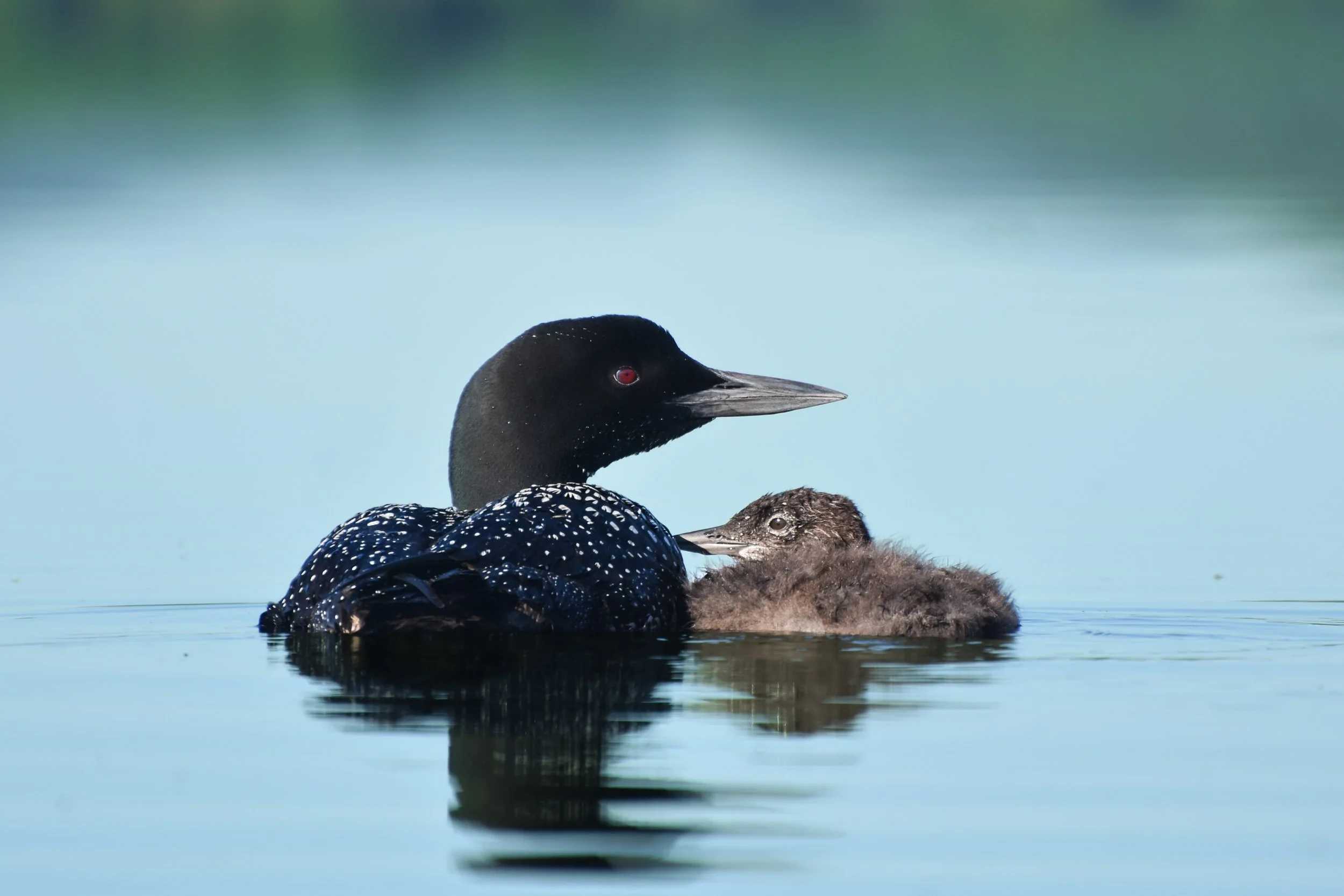
Izzie learned the different personalities of the loons on the “Big Lake.”
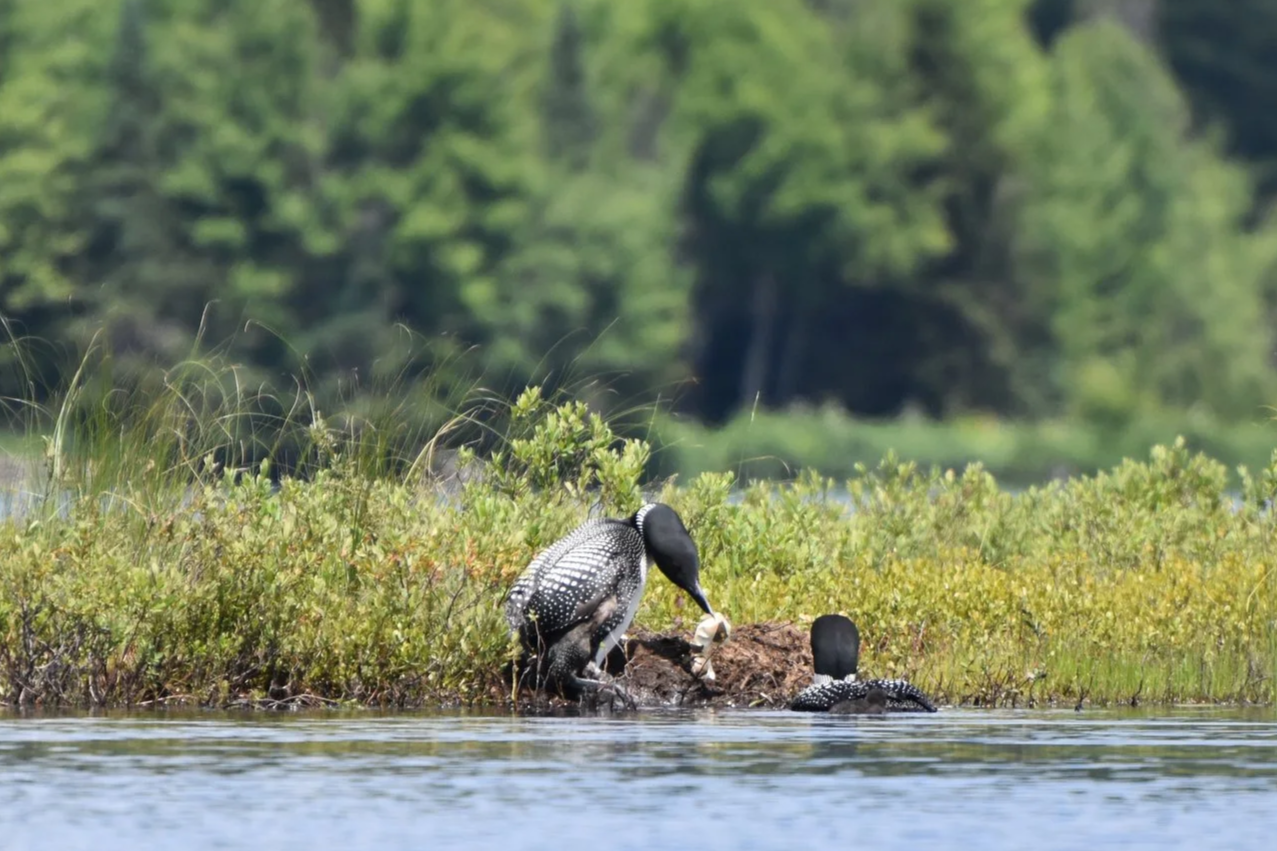
After watching a chick hatch, Izzie observed the adult loons removing egg fragments to deter predators from finding the nest.
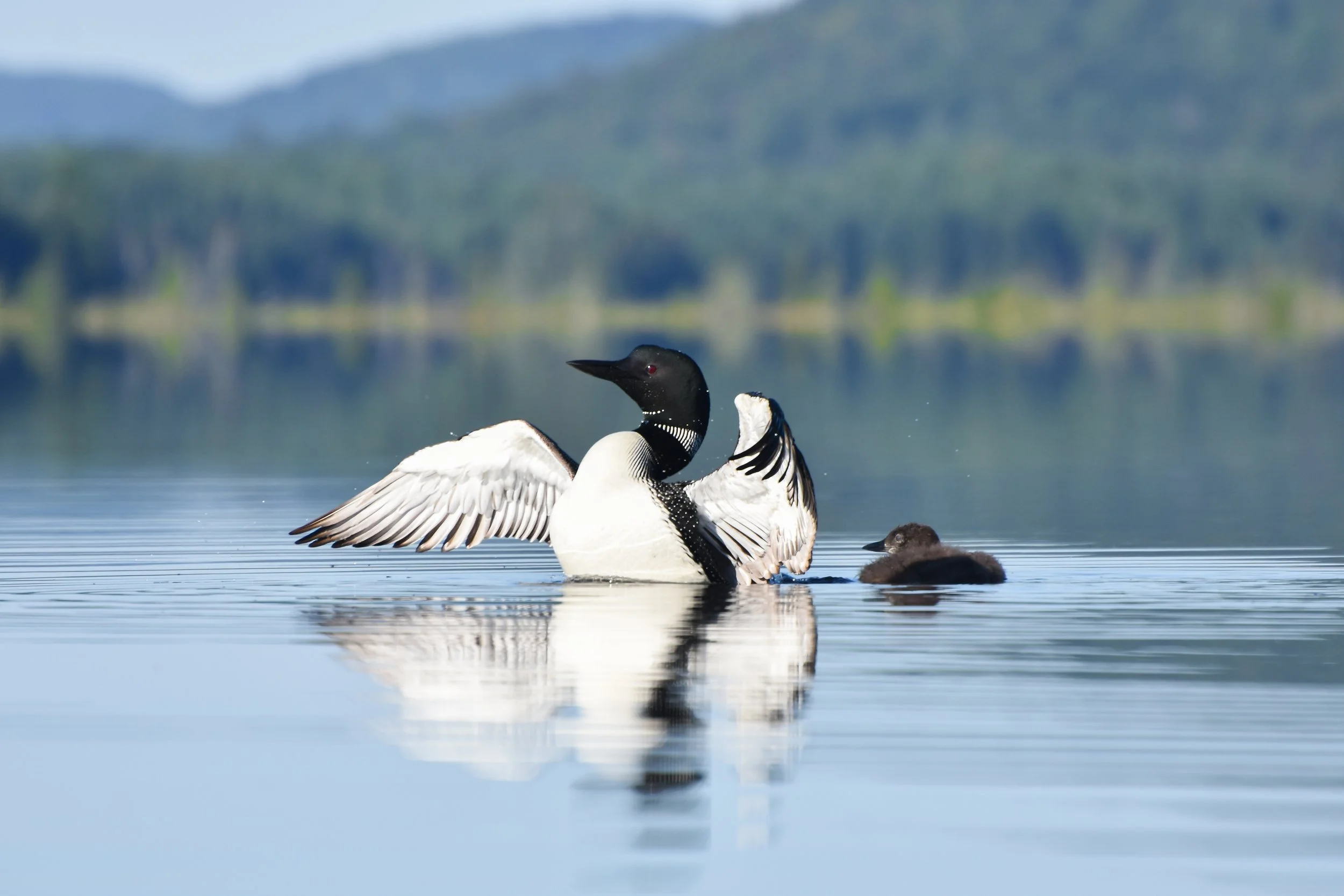
Some of the loons in Izzie’s territories were unconcerned by her presence, preening and feeding close to her boat.
The Big Lake feels like an entire world. It’s actually not that large of a lake compared to some of the lakes I spent time on in Minnesota, but it’s incredibly complex. Some of the inlets feel like tiny, quaint ponds. Cut off from the main lake, I easily forget how much water extends beyond the peninsula. One territory in the east has a huge and patchy floating bog. Surveying there means twisting around lime green sphagnum hummocks, paddling between pink sundew-covered logs and flowering purple pitcher plants. Beavers smack their tails on the water, warning me that I’m an unwelcome visitor to their corner of the lake.
A western territory also has a beautiful, but very different floating bog. That one is dominated by scrubby leather leaf, bog cranberry, and Northern Blue Flag irises. Dragonflies swarm overhead, and I hope that they might pick off the circling deer flies. Three loons reside there, a pair that quietly occupies the area behind the island, and an intruder that slinks along the edge of the bog. Another territory is small and vulnerable, just two sandy islands in the middle of the lake. The resident loon there is unpaired and always seems a bit nervous, sneaking around the island, peeking out at me from behind pickerelweeds.
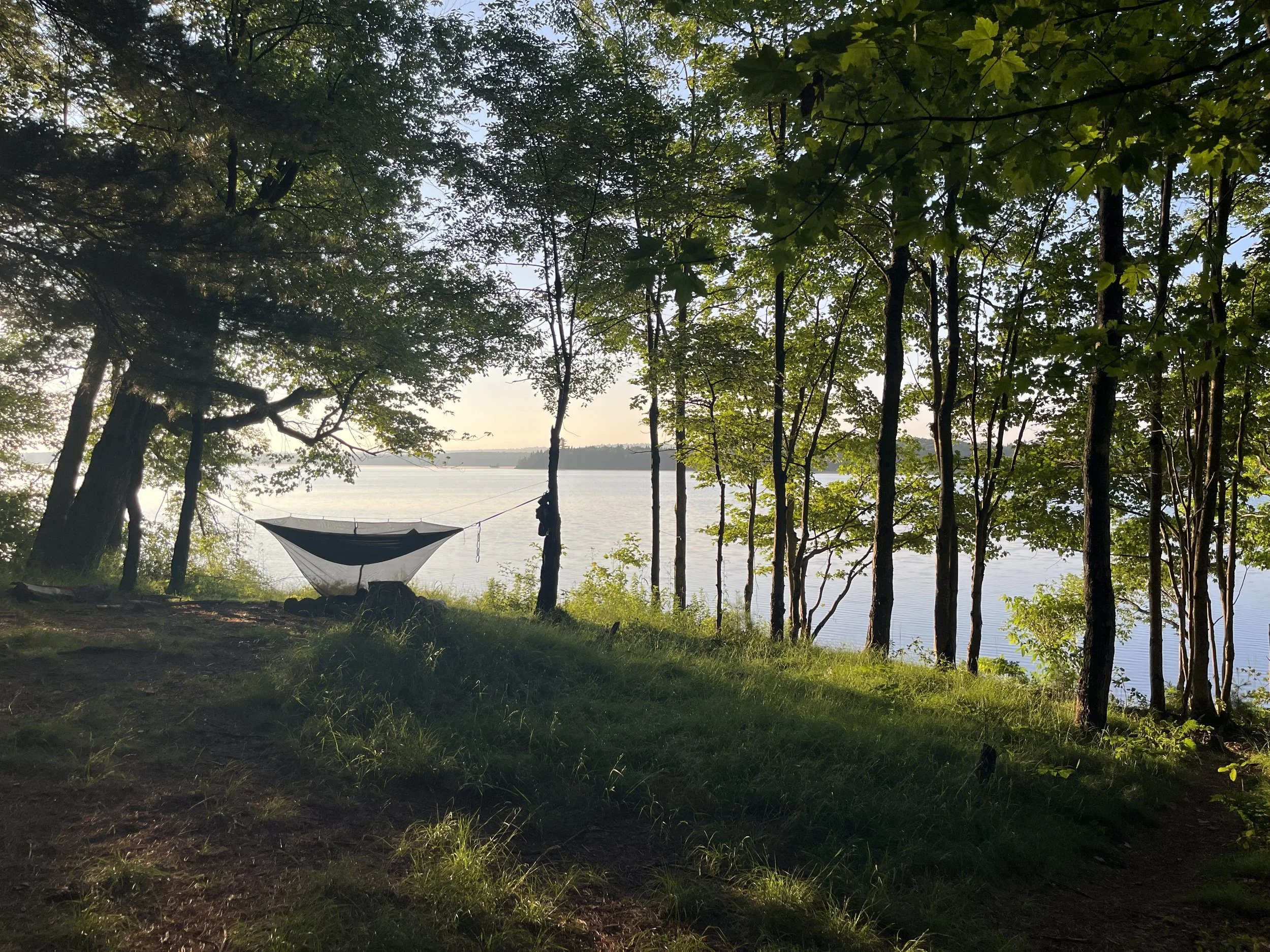
One of Izzie’s campsites when monitoring loons on the “Big Lake.”
The personalities of the loons can really shine on the Big Lake, where you can compare them so directly to each other. In the southernmost bay there’s a calm pair of loons that never seem to mind my visits. Their territory is incredibly diverse - grassy marshes to the south, two rocky islands covered in lichen in the center, and the largest floating bog to the north. They preen and feed only a few feet from my kayak. Their territory is often visited by fishermen, so they are familiar with paddlers. Their neighbors, two territories to the west, live in a massive, dark, seldom traveled bay surrounded by thick Balsam Fir and spruce forest. They will probably never trust me, and sometimes begin tremoloing right as I cross into their territory, even if they are hundreds of feet away. My favorite pair dominate the open water in the center of the lake, and the northeastern part of the big floating bog. They are spunky and brave: one of them is banded so I can always identify him. I see them take boundary crossing trips into neighboring territories often, and fight off intruders almost instantly when they pass through their home.
There are endless stories I could tell about the Big Lake, but most of those will never be shared with anyone except for the loons. I almost always work alone, and have gone entire trips without seeing anyone. The first time I paddled the big lake, when ACLC Research Biologist Griffin Archambault was teaching me how to survey so many territories at once, it felt like a huge abyss, like I could never possibly know every part of it. Now, I’ve taken the time to explore every bay, every inlet, the back corners of every bog. I’ve stopped at most of the islands and landings for lunch, and taken a few minutes to wander into the woods. I’ve spent nights at several of the campsites there, and learned where to pick berries and filter my water. As of my second to last week of work, I’ve visited every single part of the lake. It feels much smaller and gentler now. The big lake has truly become a part of who I am, especially since it has controlled much of my life here. My weekly plan revolves around calm weather for crossing the Big Lake. It controls the food I eat, the muscles I stretch, the amount of water I drink, the gear in my bag, and the sleep I get. To have such an intimate relationship with wilderness is something that’s hard to achieve in the modern day, and the hard work that goes into surveying the Big Lake is a huge part of what makes it special.
Throughout the summer, I’ve been reading Woodswoman, By Anne LaBastille, where she writes about her remote cabin life in the Adirondack Wilderness. Near the end of the book, she writes, ”My existence here has not been, and never will be, idyllic. Nature is too demanding for that. It requires a constant response to the environment. I must adapt to its changes—the seasons, the vagaries of weather, wear and tear on my house and my land, the physical demands on my body, the sensuous pulls on my senses. Despite these demands, I share a feeling of continuity, contentment, and oneness with the natural world, with life itself, in my surroundings of tall pines, clear lakes, flying squirrels, trailless peaks, shy deer, clean air, bullfrogs, black flies, and trilliums.
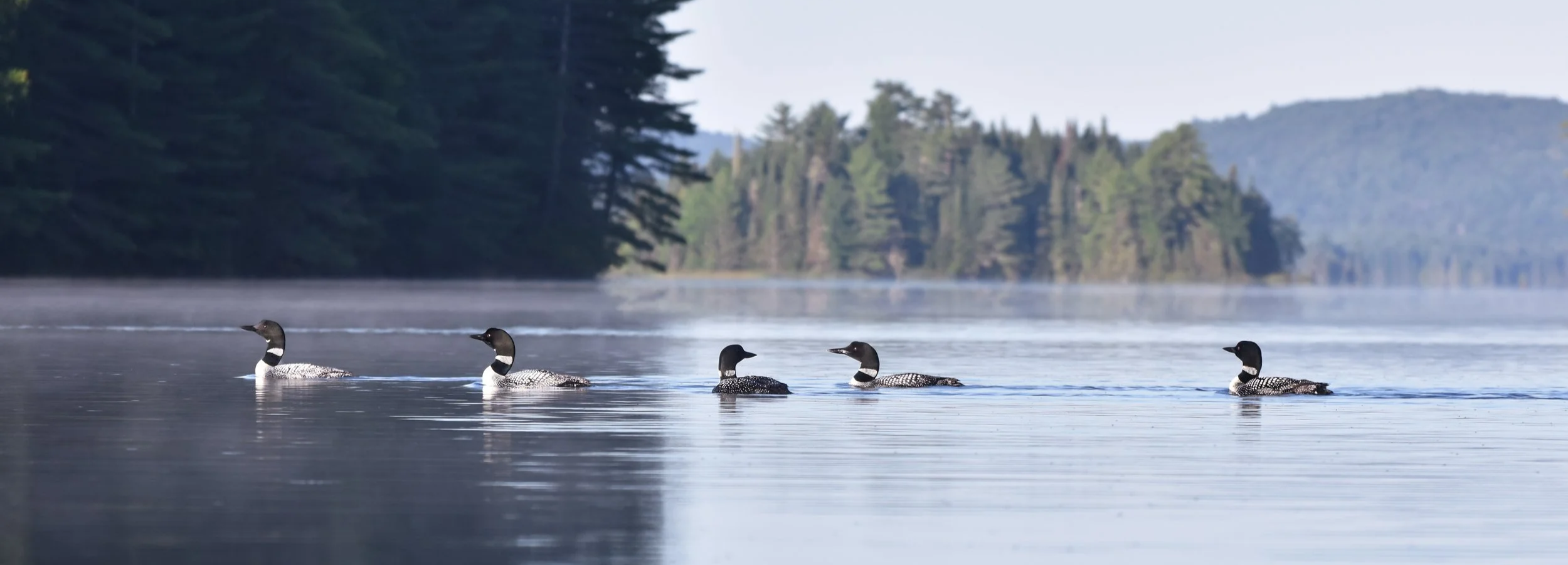
Loons gathering on the “Big Lake” where Izzie McGinley Myers spent two days of her work week monitoring multiple territories.
Sitting in my cold Minneapolis house in February, homework waiting at my desk, a summer paddling in the remote Adirondack wilderness did sound idyllic, like a dream come true. I’ve had many difficult days on the big lake, high winds pushing my paddling skills to their limit, swarms of black flies somehow slipping into my bug net, blistering hot days, freezing cold nights. There have also been wonderful surprises like massive rose begonia blooms, the occasional bear sighting, bushes full of blueberries, the excitement of finding a new nest, the incredible day that I watched a loon chick hatch. Despite my growing familiarity with this place, I will never be able to predict how each trip will go. This is the nature of loon monitoring. While a childhood dream led me here, the real challenges of wilderness fieldwork are infinitely more satisfying than anything I could have imagined.