
Counting Loons as Family Tradition
Words by Melanie Hirsch, ACLC Volunteer
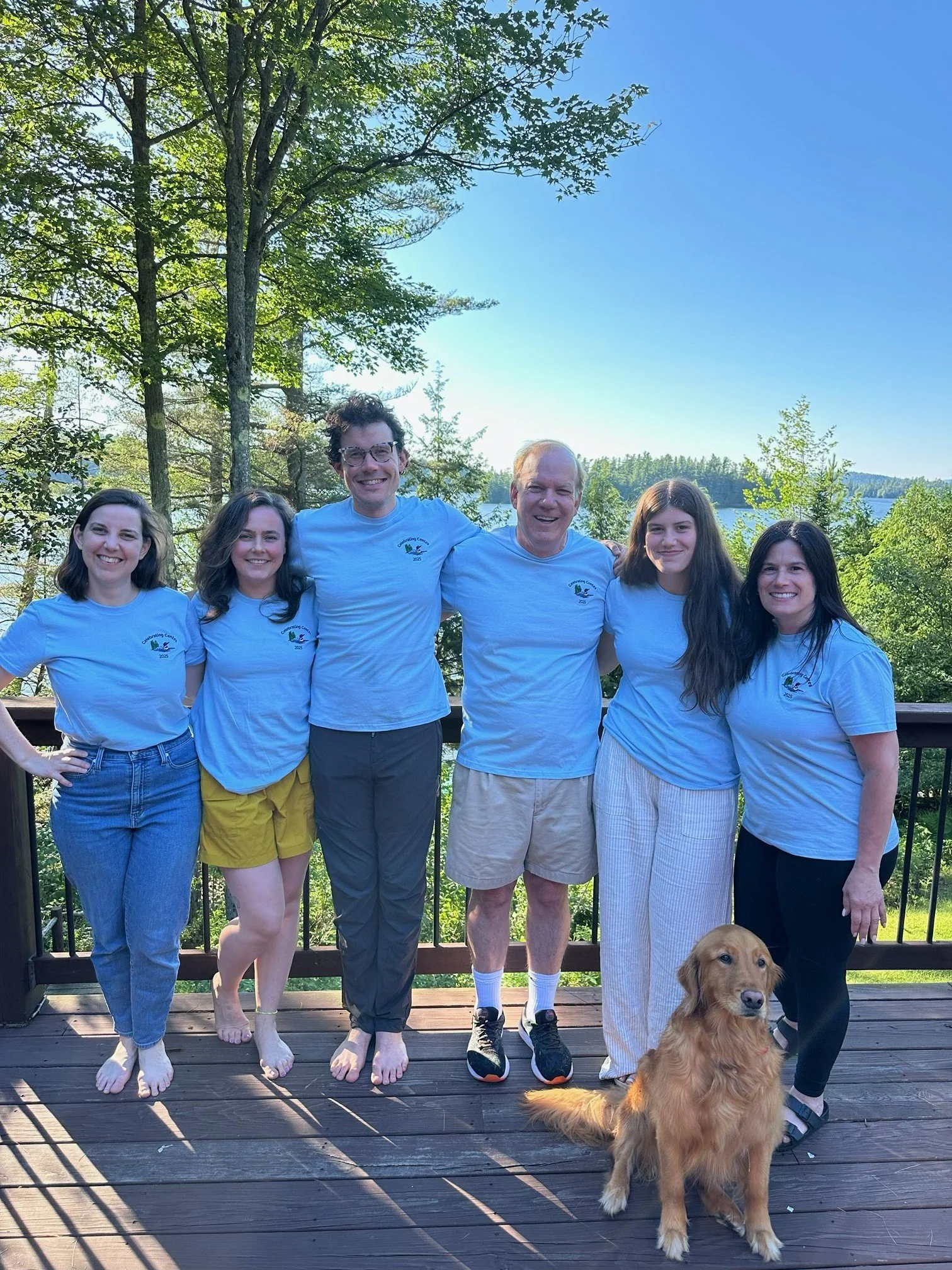
Dan Papes, fourth from left, and his family with Upper Saranac Lake in the background. Photo provided by Dan Papes.
There was a time, well within the reach of recent memory, that Dan Papes traveled around the world, crisscrossing continents, in his role as a top executive for Fortune 500 and Fortune Global 500 companies.
Singapore, Montreal, other bustling hubs of business, culture, and commerce. Dan jetted to, and conducted business in, them all.
But on the third Saturday of July? Dan wasn’t fighting crowds in a concrete jungle. That day was different, if not a little sacred, in a uniquely Adirondack and sapphire-blue water kind of way.
That day, with the help of an efficient and determined assistant, he migrated home to his special place, a lake he and his family call “heaven on Earth,” and to the striking black and white loons that inhabit it.
“My assistant knew that having me in one place was very unusual, and we’d often go to great lengths…to get me back” to Upper Saranac Lake in time, said Dan, who added that it wasn’t unusual to arrive at midnight to make sure he was on the water eight hours later.
“It took a lot to make it work, but we did it,’’ Dan recalls with a chuckle.
The “it” that was - and is - so important to Dan was the New York Annual Loon Census, organized by the Adirondack Center for Loon Conservation (ACLC). Dan and his family have participated in the yearly count since 2003.
“It’s interesting how the Adirondacks are in our family’s blood,” says Dan, who divides his time between his family compound on the pristine Upper Saranac Lake and the Town of Chappaqua in Northern Westchester County. “The lake - and the loons - are embedded in our DNA.’’
Volunteers such as Dan and his family have dutifully collected data for the state-wide NY Annual Loon Census since 2001. It always takes place for one hour on the third Saturday of July.
Dan and others stationed in boats or on shore on serene New York lakes, ponds and rivers are responsible for their own zones, counting adult loons, downy chicks about the size of a human fist, and young juveniles who have not yet fledged.
For ACLC biologist Griffin Archambault, volunteers are vital players in helping researchers better understand loons and the challenges they face in the twenty-first century.
“It’s important to count loons because loons are a great bioindicator species,” says Griffin, noting that the birds with the haunting cries reflect the health of an entire ecosystem. Loons serve as bellwethers to the abundance of food or lack of it, water clarity, even the presence of pollution.
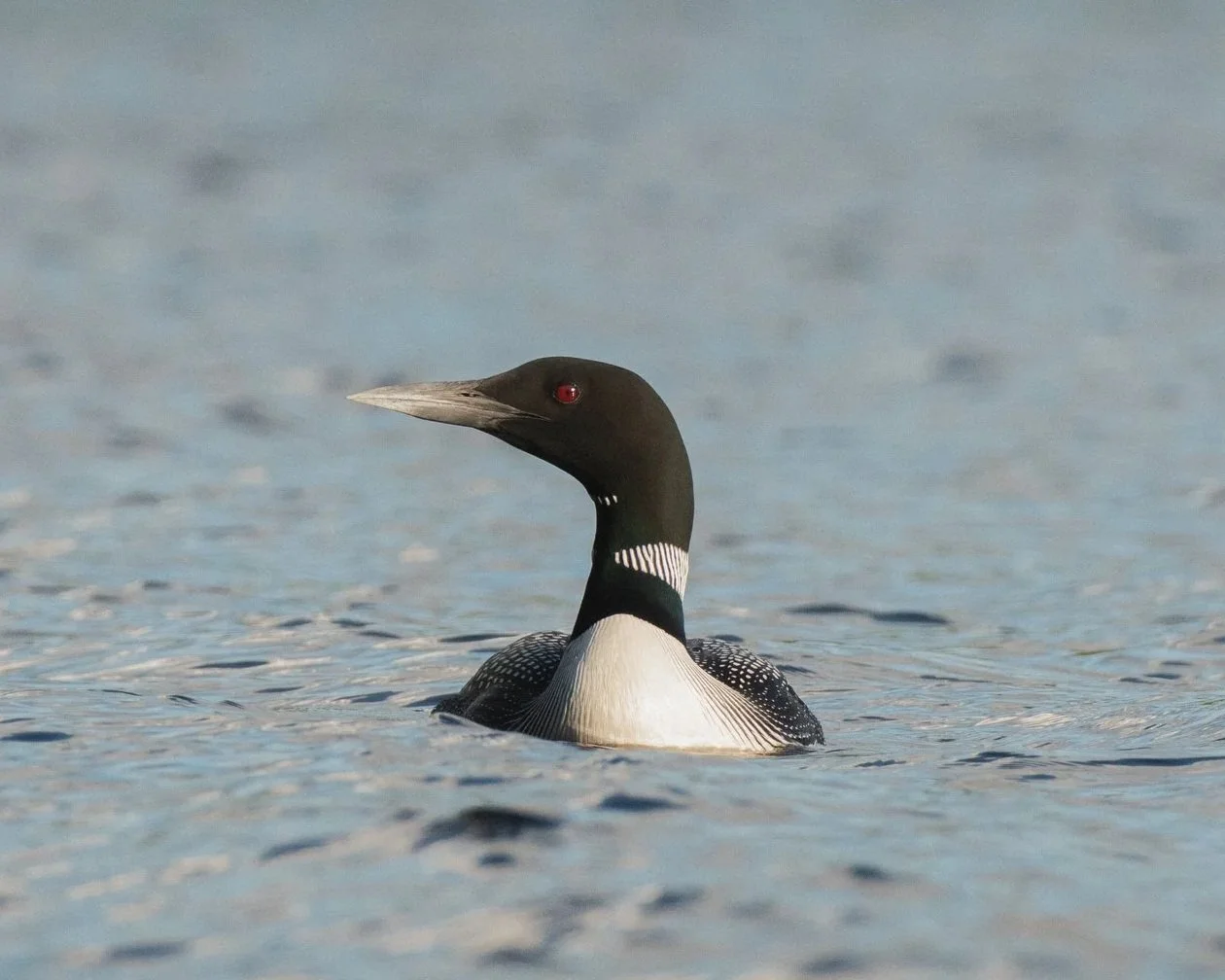
The NY Annual Loon Census provides important data for estimating the population of loons in the state. Even if volunteers see zero loons during the census hour, that is still important information for Loon Center researchers. Photo by Chris Peirce
And because loons are designated by the state as a “species of special concern,” the census helps the NY State Department of Environmental Conservation make management decisions about the birds, including whether their numbers are high enough to remove the “special concern” label, which has not yet happened.
This year the census will take place from 8 to 9 am on Saturday, July 18, 2026. Registration is now open for this year’s census and will close at 5 pm on July 1.
During the 2025 census, 815 volunteers like Dan and his family counted loons on 306 lakes, ponds and rivers across the Empire State.
Their findings? More than 1,000 loons - 1,059 in fact - were spotted on New York’s waterways. Best of all, it was the first year the census found more than 1,000 loons across the state, a milestone for loon lovers across the 6-million-acre Adirondack Park.
However, in this era of unrelenting climate change, the news is not all good. What scientists like Griffin call “nest survival” - the number of chicks that hatch - is dropping. Scientists suspect climate change, particularly torrential rain, is to blame.
More rain, especially during the month of June, when adult loons sit on eggs to keep them warm, can flood nests, causing the eggs to float away. Or, Griffin says, cold water fills the nest, causing the temperature of the egg to drop, which spells the end of the developing chick inside.
“We are,’’ Griffin says, “seeing more and more nest flooding’’ with climate change. Weather is changing so fast, he added, that species such as loons are having trouble adapting fast enough.
For Griffin, folks like Dan are the foundation of the entire census.
“Volunteers ARE the census,’’ he says. “They are not just important, they are vital.’’
And he reassures volunteers who don’t encounter any loons during the census and end up with a data point of zero that they shouldn’t worry.
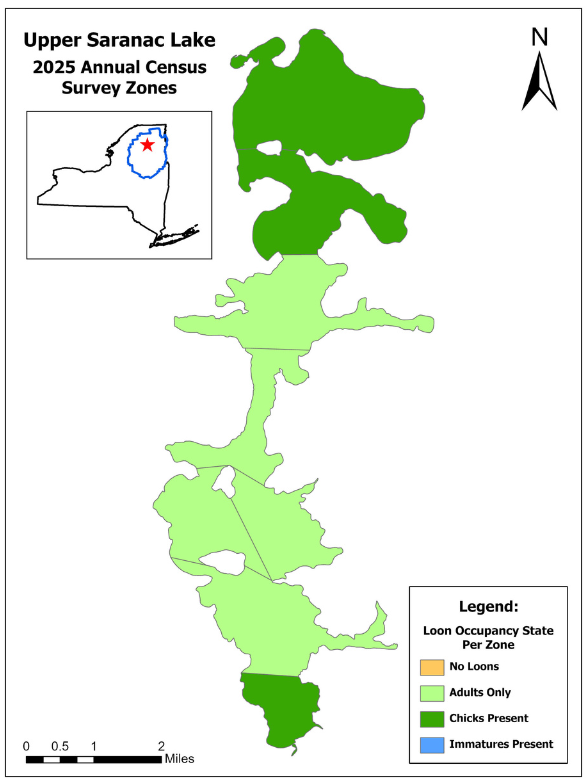
During the 2025 census, volunteers counted 42 adult loons and six chicks on Upper Saranac Lake.
“People apologize if they don’t find loons,’’ Griffin says. “They shouldn’t feel bad. If there are no loons in an area, there’s a reason for that and we need to know that, too. If volunteers don’t see something, they are still giving us valuable data.”
For some folks, taking part in the census is not only a way to give back and spend time on the same lakes that loons love, it’s a way to bond with family. Dan, who retired from the Fortune 500 companies and now owns an athletic business in Westchester County where folks play sports indoors, heard about the census more than two decades ago.
His hunch that the census sounded interesting paid off. Not only was it fun to get up in the morning and start counting the loons, he notes, “it became a great family activity.”
“I’ve missed only one year and my three older kids did it in my stead,” says the father of four. “It is,” he adds, “a very important family tradition.”
Dan is in charge of the largest zone on Upper Saranac Lake. With the same meticulousness and precision he displayed as an executive, he searches for loons by scouring near “a lot of little islands, nooks, crannies and channels,” he says.
He even goes so far as to draw a map of his zone so he can better track the adults, chicks and juvenile loons he is counting.
The payoff is twofold.
“One of the most special things we see during the census is the interaction between the parent loons and chicks,’’ Dan says.
There are special human moments too, such as when a friend spots an adult loon and is spellbound.
“It is very special to see someone light up when they see that,’’ Dan says.
Dan developed his love of Upper Saranac Lake and loons when his parents, then living in Paris, bought a lot on the lake shore sight unseen after a friend sent them a classified ad listing the property in the early 1980s.
In the years since his parents built their home, and he followed suit as an adult, the lake and loons became intrinsically linked to a sense of calm.
“My work life is very fulfilling but also very stressful,’’ Dan says. “The lake - with its loons and their calls and the census itself - is my peaceful place.’’
Given Dan’s love of both lake and loons, it’s a good bet he will be counting on census day for another 23 years.
The only difference? He won’t have to rush here from another continent to come home and count in his beloved sanctuary of calm and serenity.