
Iced-in Loon on Clear Pond
Words by Leah Boget, ACLC Wildlife Technician
Video and images by Glenn Smith, ACLC Volunteer and Wildlife Photographer
On Tuesday, December 2, Glenn Smith noticed two juvenile loons becoming iced-in on Clear Pond in Franklin County, NY. Glenn trained as a summer rescue volunteer with Adirondack Center for Loon Conservation (ACLC) in 2025, and is a wildlife photographer who documents loons.
On December 1, the pond had been free of ice, but with the cold snap rolling through there had been enough ice formed to cause concern for the two young birds. Each year there are some loons caught in freezing conditions before they leave for the winter. Juvenile loons are often caught in the ice because they are still learning the cues to migrate.
Glenn returned to the pond each day until December 5 to photograph and report on the state of the forming ice. Volunteer rescuers waited on standby until conditions were right.
On Friday, December 5, ACLC Research Biologist Griffin Archambault and Wildlife Technician Leah Boget visited the pond to assess the situation in person, by which time one of the young loons had been able to leave of its own accord. Loons typically need a long runway of open water to take off, but with luck, a good head wind and enough confidence to use the ice as part of their runway, they can sometimes manage to get airborne from even a smaller hole of open water. This is one of the reasons that ice rescues are not immediately attempted.
On the morning of Saturday, December 6, Glenn sent photos of the pond and Griffin determined that conditions were right to make a rescue attempt. Three other trained volunteers showed up for the Saturday outing: Susan Nolde, a rescue volunteer, Joe Poliquin, longtime ACLC summer field staff and rescue volunteer, and Julie Harjung, a retired Forest Ranger and experienced iced-in loon rescuer.
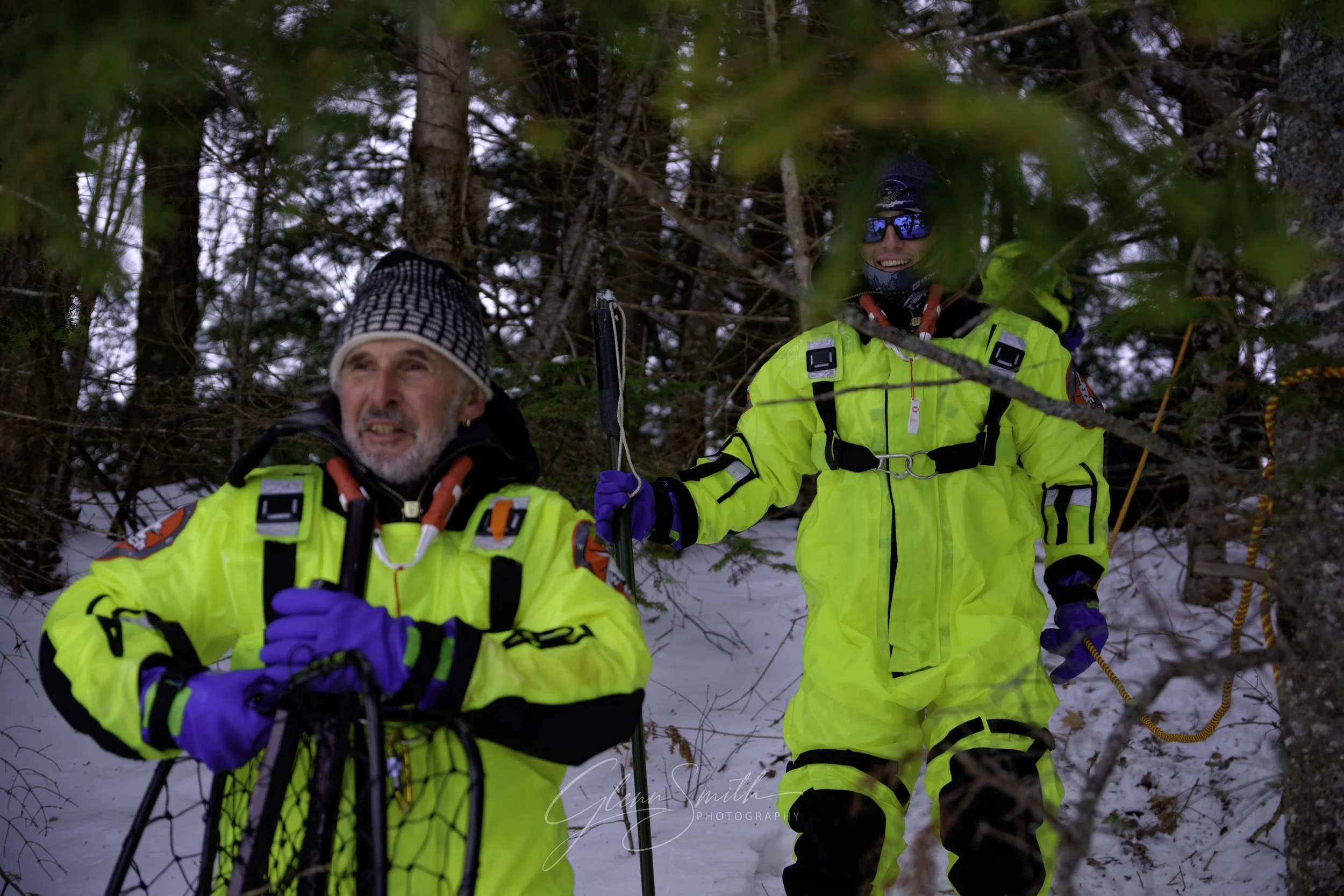
Rescue volunteers suiting up in the Gumby suits.
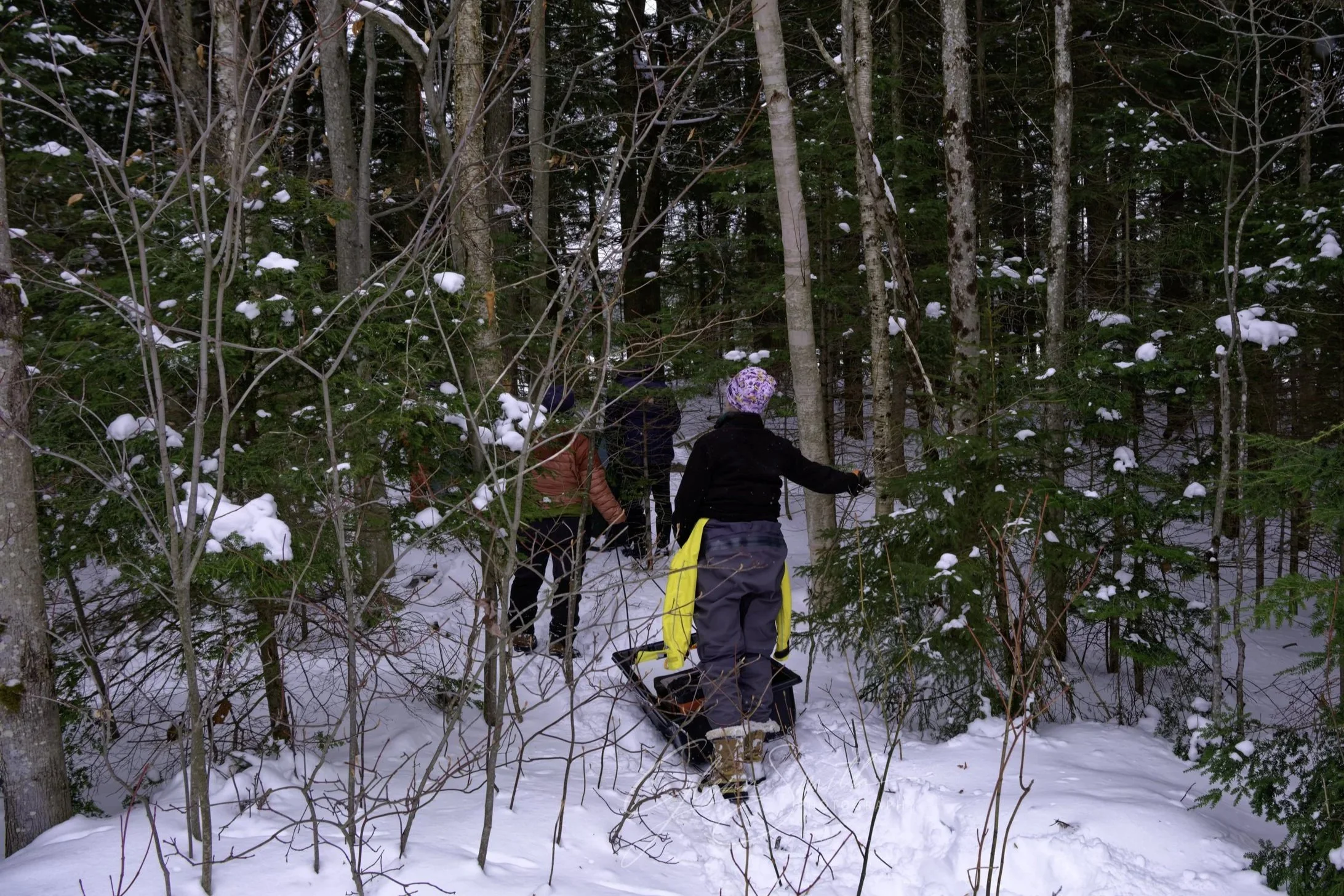
Rescue volunteers getting supplies to the pond.
Trained rescuers suited up in Gumby suits, which are waterproof and insulated suits with built-in flotation that are used by fire departments and other cold water rescue organizations. A safety rope was tied to a tree on shore and to one end of the jon boat. Julie took the lead on the ice to test the safety with an ice spud, a tool used to determine ice thickness based on the sound and impact depth of hitting it into the ice before continuing forward. Griffin followed a short distance behind with the jon boat and a handled net. While the hole with the trapped loon was only a short distance from shore, it took Julie and Griffin almost 15 minutes to make the crossing, as they stopped along the way to let the loon become accustomed to their presence to lessen its stress. Trapped loons will often continually dive under the water to stay away from people, surfacing only to breathe before diving again. Joe and Susan stayed further back during this first approach to help lessen the human presence.
Once the rescuers made it to the hole in the ice, Griffin got in the jon boat and Julie pushed it into the hole for Griffin to make a first attempt at capturing the loon using the handled net. The first attempts were unsuccessful as the loon was very agile, so the gill net was brought out. Gill nets are large fine-mesh nets that sink from weights on the bottom while the top remains afloat. The goal is to get the loon to swim into the net, where it would become tangled and rescuers would be able to pull it ashore. Joe and Julie held the gill net across the hole while Griffin attempted to spook the loon into the gill net with his handled net. Instead, the loon became spooked by the gill net, and Griffin was able to scoop the loon up himself.
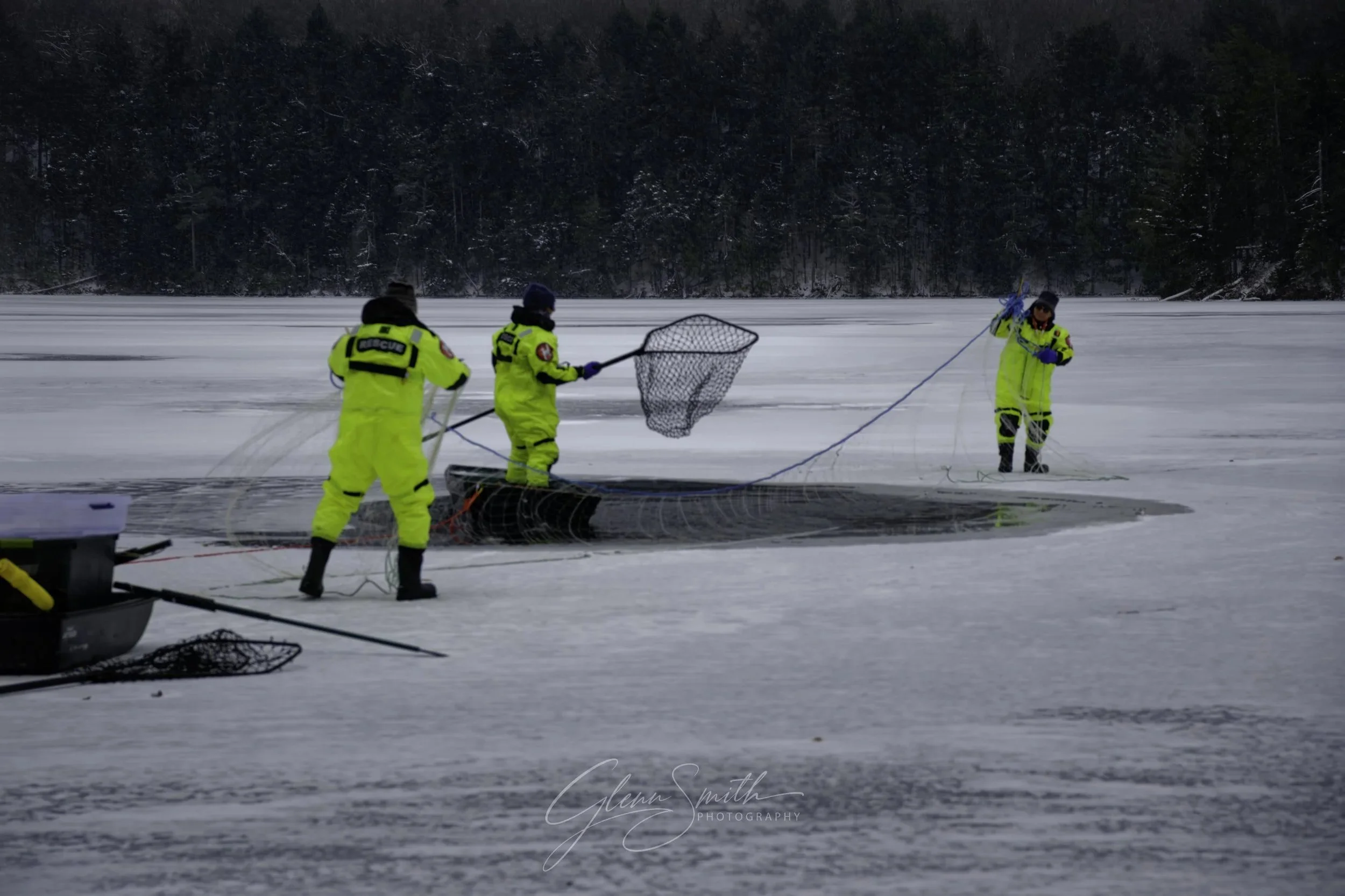
ACLC Research Biologist Griffin Archambault stands on the jon boat while volunteers Joe Poliquin (left) and Julie Harjung (right) string the gill net across the opening in the ice.
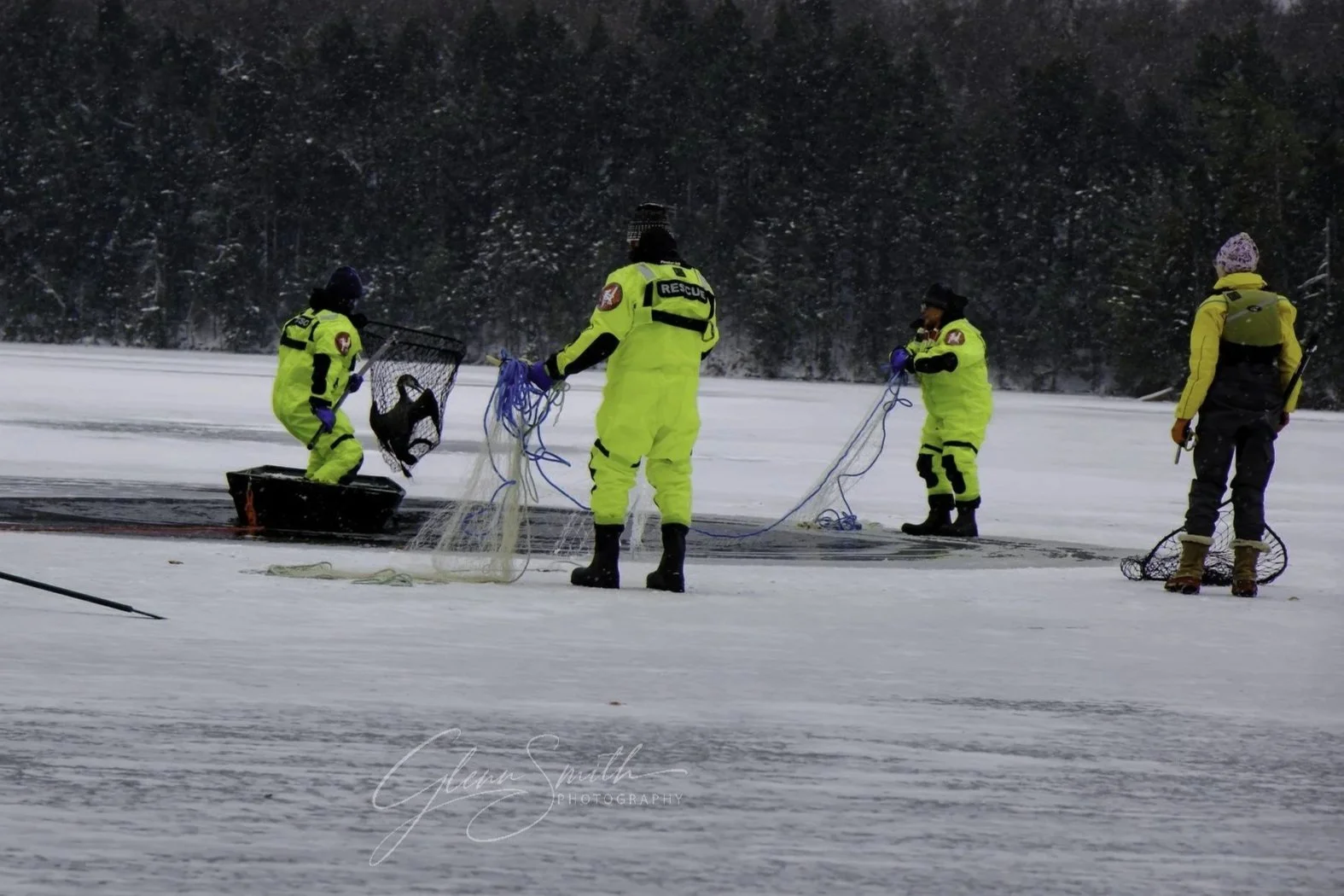
ACLC Research Biologist Griffin Archambault and volunteers Joe Poliquin, Julie Harjung, and Susan Nolde at the moment Griffin successfully nets the loon.
After pulling the boat back onto the ice, Julie and Susan helped Griffin handle the loon and place it into a capture bin. ACLC loon capture bins are large plastic bins that have many air holes and netting across the lower section for the loon to sit on so that the bird isn’t resting on its fragile keel (the avian version of a sternum). Once the loon was safely in the bin, the rescue crew grabbed their gear and brought the operation back to shore, where Glenn had been photographing the event.
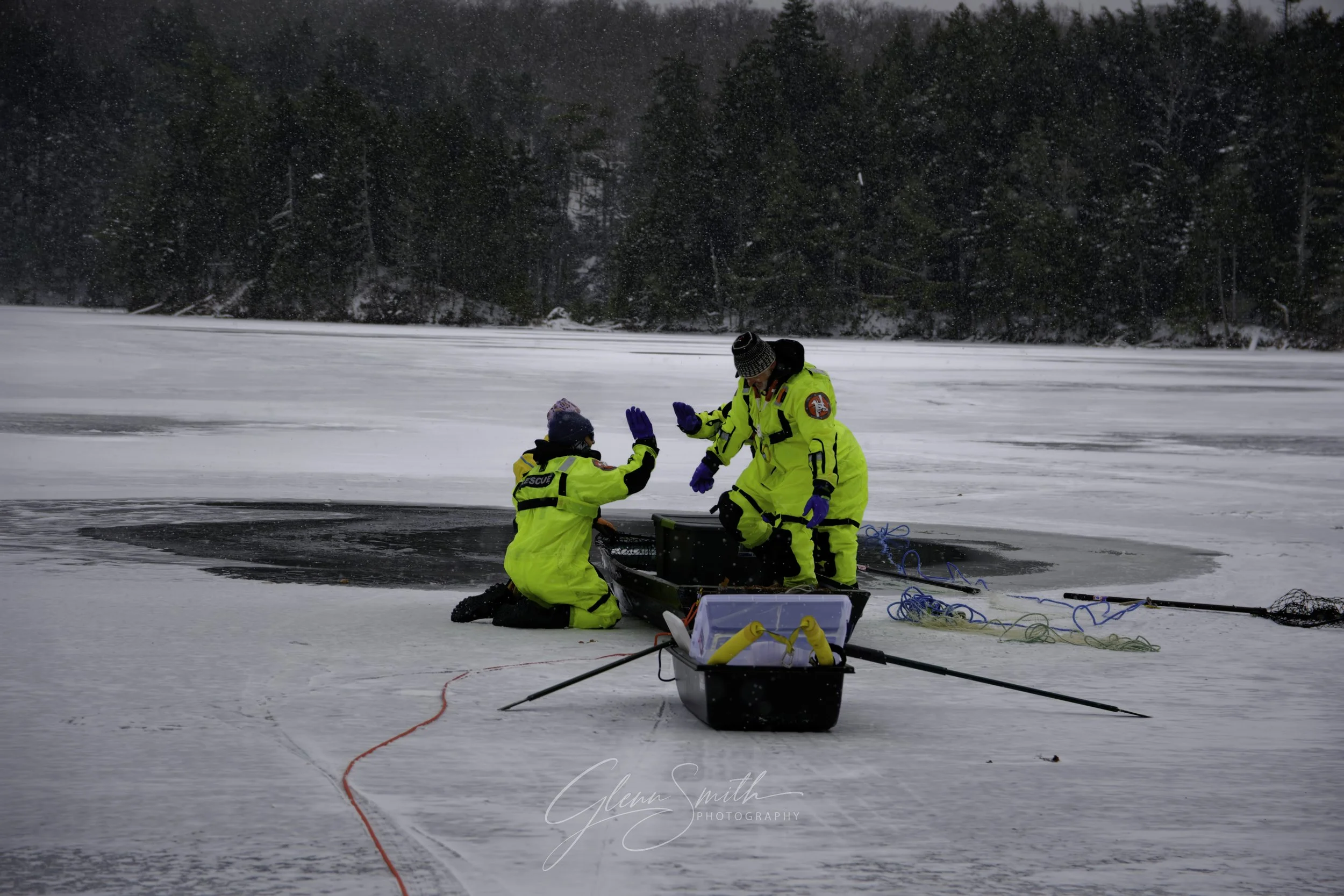
Rescue volunteer Julie Harjung and ACLC Research Biologist Griffin Archambault celebrate with a high five.
The loon was brought to a local wildlife vet for a workup: taking some measurements, securing blood and feather samples, and checking overall health. Blood work for adult loons reflects recent mercury exposure, while feather samples are representative of longer-term mercury intake since flight feathers are grown while on the wintering grounds. This loon was a hatch-year juvenile still on its natal lake, meaning any mercury levels present in its feathers are also representative of exposure on Clear Pond. Mercury levels in loons have been declining in the Adirondack Park since around 2011, when the impacts of effective air emissions controls began to take effect. Mercury deposition and acid rain, both of which come from coal plant emissions, will increase again if these regulations are reduced or repealed.
After a workup, loons are banded with two bands per leg that form a unique color combination. As this loon was a juvenile, the silver USGS band was placed on its left leg under a white stripe band, and white dot over orange was put on the right leg. Band re-sightings allow us to follow loons throughout their lives as we can identify them to the individual, and since this loon was banded as a juvenile, we will know its exact age when it is re-sighted later in life.
The rescued loon was then driven to the Westport Boat Launch on Lake Champlain, a site that will allow it to take time to rest and feed before continuing its migration. This juvenile is likely headed to the Atlantic Ocean, where most loons in the eastern US and Canada spend the winter. As a juvenile, this loon will spend the next two years on the ocean before growing its mature black and white checkered plumage and returning to summer territories. We look forward to hopefully seeing this loon return to the Adirondacks in the future as a healthy breeding adult!
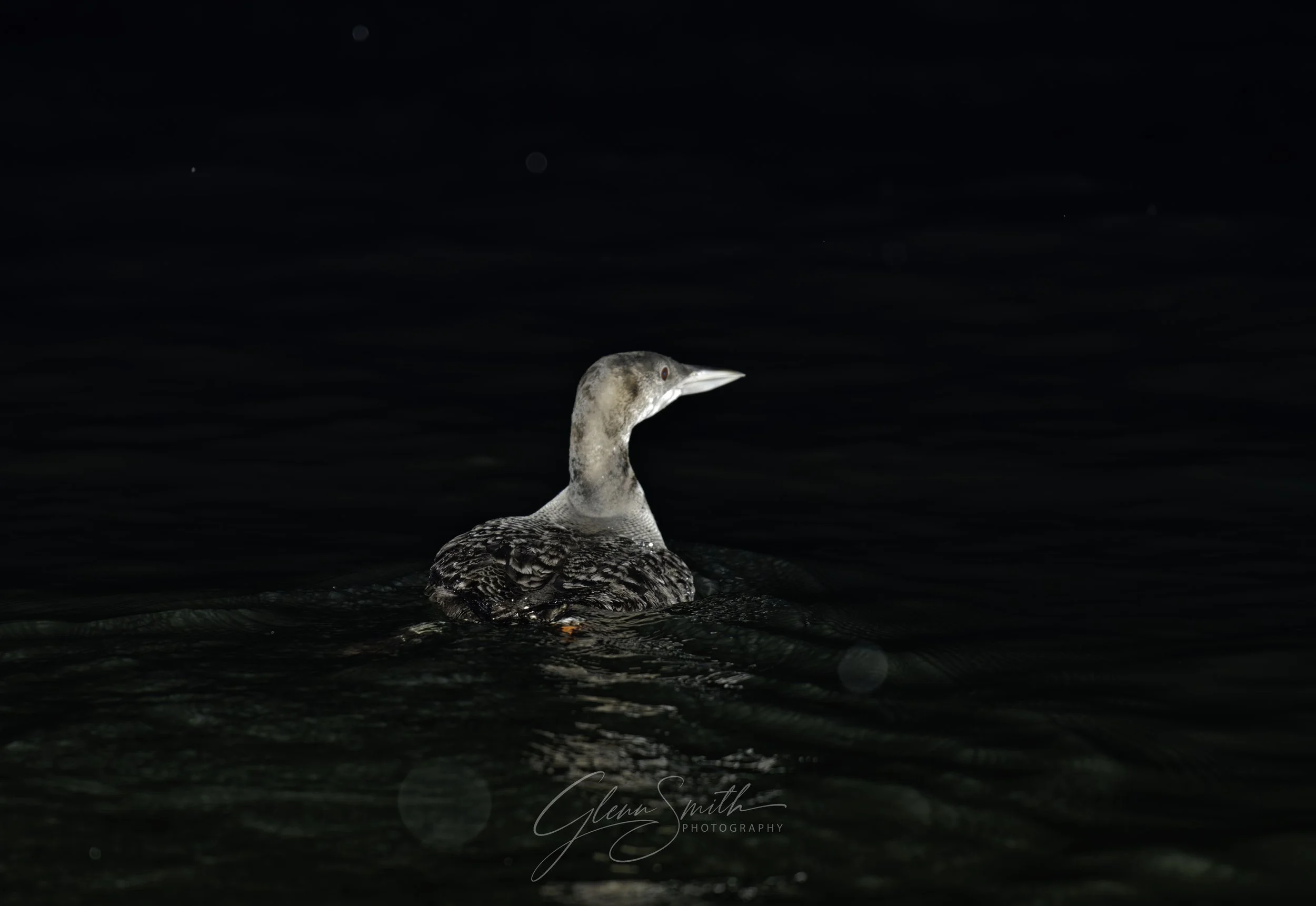
The rescued juvenile loon after being released on Lake Champlain, where it can feed, regain its strength, and hopefully make a successful migration to the Atlantic Ocean.
ACLC prioritizes human safety above all else when conducting loon rescues. If there are not enough trained personnel available or conditions are deemed unsafe because of thin ice, ice over moving water, or holes miles from shore, a rescue will not be conducted. All personnel who participate in ice rescues must be trained in both self-rescue and rescue of others in case anyone falls through the ice. ACLC hosts annual ice training taught by a member of a local fire department, typically in January or February.
Special thanks to Glenn Smith for spotting the trapped loons, and for returning each day in the cold and snow to keep an eye on the situation. Thank you as well to the rescue volunteers that conducted a safe and smooth first ice rescue of the winter!
If you see a loon in distress this winter, such as an iced-in loon or a grounded loon, please call the Adirondack Center for Loon Conservation at 518-354-8636 or email rescue@adkloon.org. Be prepared to share your name, the location of the loon, a description of the loon’s condition or behavior, and any photographs or video you are able to capture to help ACLC staff assess the situation.