
Loon Drama on “Lake Whatsit”
Words by Eden Wondra, ACLC Wildlife Technician & Lead Programs Coordinator
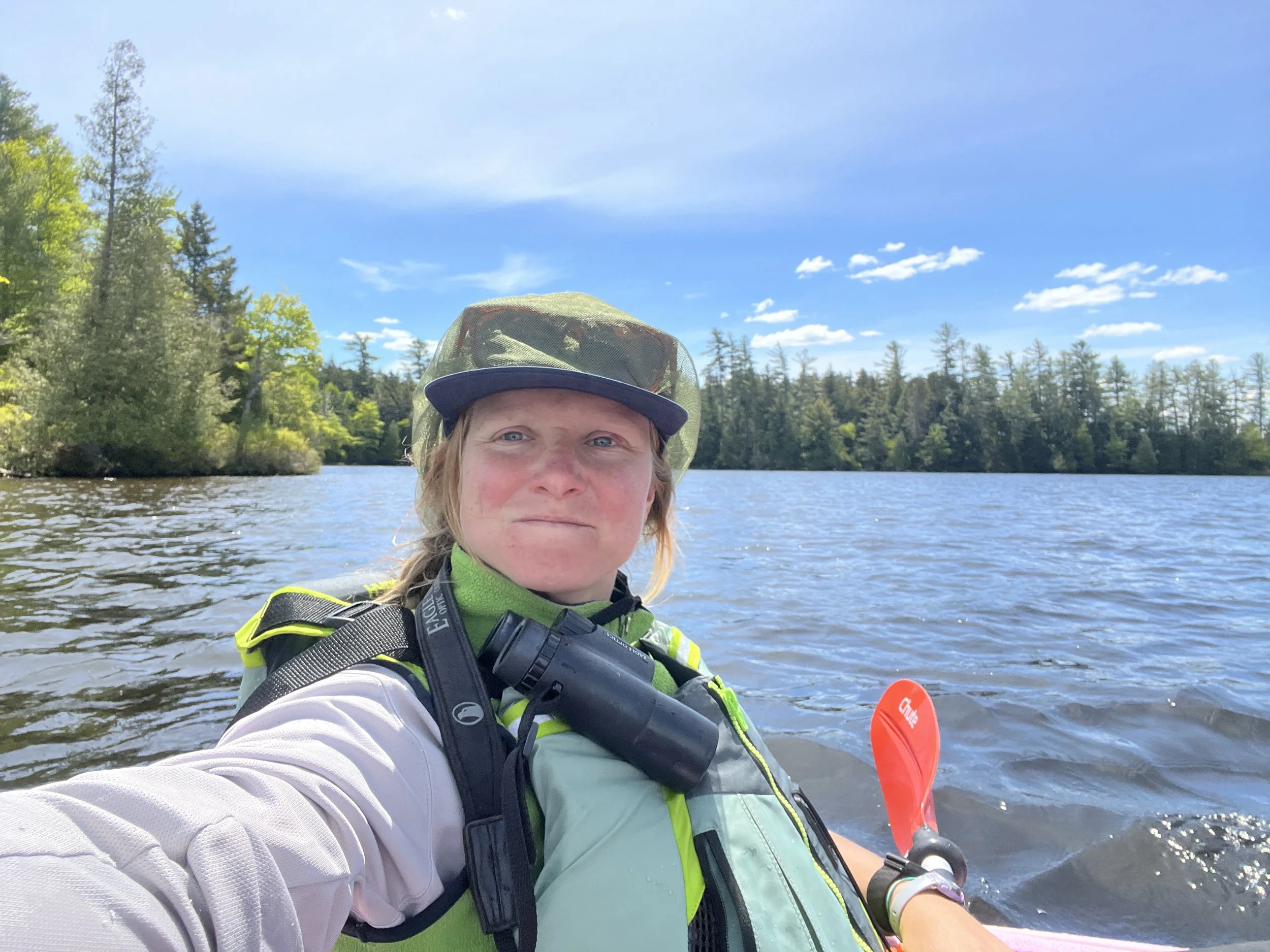
Wildlife Tech Eden Wondra is enjoying her summer lake monitoring duties and learning a lot along the way. Photo provided by Eden Wondra
I was thrilled to be offered the seasonal position of Wildlife Technician at the Adirondack Center for Loon Conservation this summer. As part of my role, I monitor banded loons on three lakes, covering five loon territories. It has been an opportunity to learn more about Adirondack lake ecosystems through the lives of Adirondack loons, and so far, the experience has not disappointed!
On one of my three assigned lakes, let’s call it Lake Whatsit, my monitoring season started with eerie silence and an unnatural absence of loons.This was supposed to be a lake with two territories. Historically, rescued loons were released here and nesting occurred yearly. It was the place I was told by everyone who knew anything about loons that this is where I’d see the loons! So where were they?
Then I found a friend. Well, I called him my friend, but I clearly was not his. Shyguy, as I came to call this loon, liked to dive and reappear half way across the lake every time I turned my kayak in his direction. Using an incredible ability to adjust his buoyancy, Shyguy peered at me just above the peaks of the waves before diving once more and popping back up yards away. I spent hours trying to see the leg bands of this loon to no avail.
Weeks of checking the historical territorial bays on Lake Whatsit only to have them turn up empty left me disappointed, until one day, I arrived at the North Bay to find two loons happily fishing together. Finally!
“Maybe it was Shyguy,” I thought. “Maybe he found a mate!”
It was a beautiful, calm, sunny day, and I was able to quietly watch the pair from a distance, looking for leg bands through my binoculars. It was the most relaxing moment of field work I had had so far.
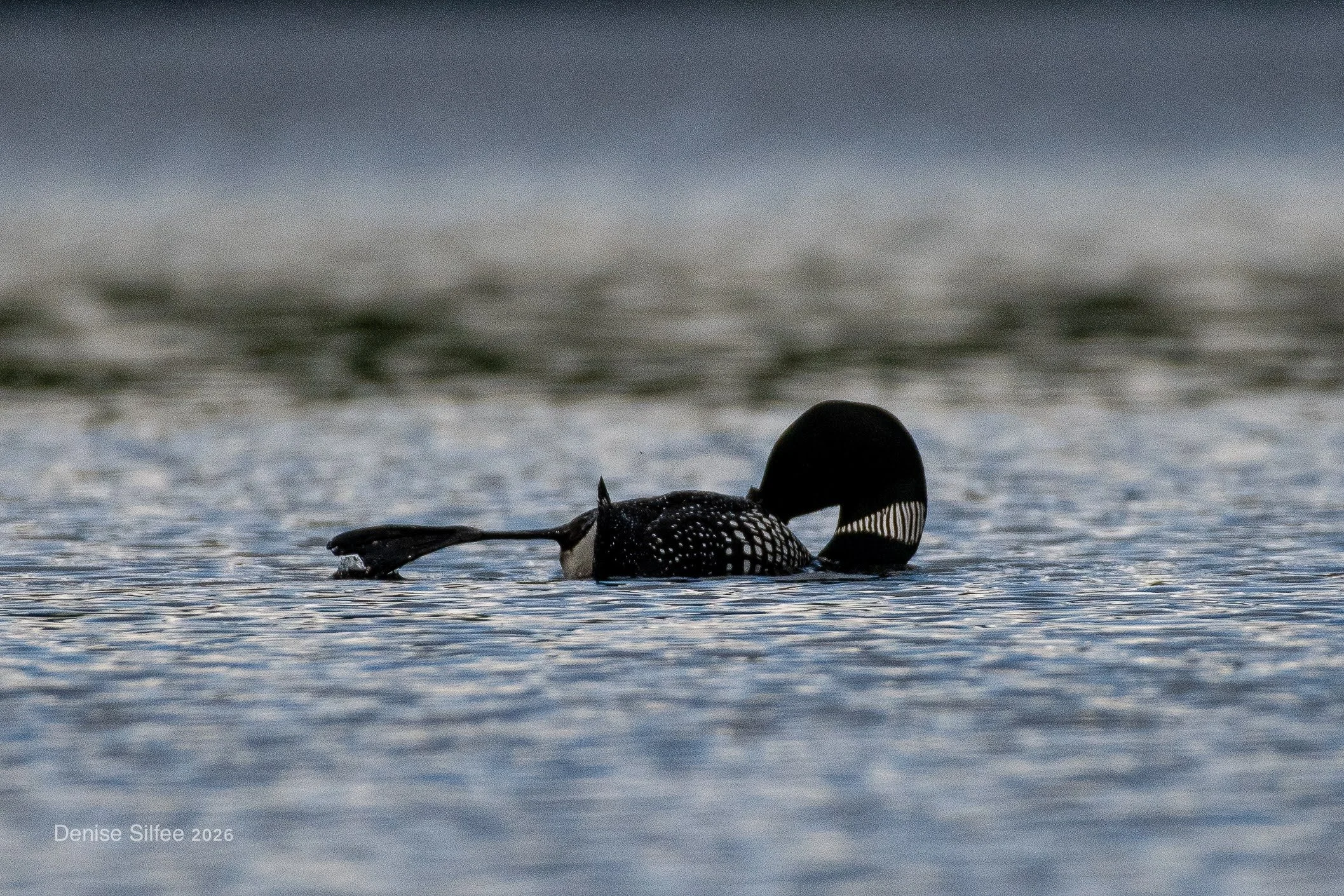
For a while, “Shyguy” was the only loon Eden Wondra found on “Lake Whatsit”. Photo by Denise Silfee
Until the silence was broken by a loud “hoot,” almost like an inquiry or warning. I turned my head to see two large loons, side by side, quickly gliding towards my loons, eyes locked on their target, headed for the attack. And attack they did. The bay broke out into a scene of splashes, dramatic dives, dips and chases. No sooner did I paddle my kayak out of the way then I had to turn it around to try and follow the quarrel as they chased each other out of the bay and out of my sight. I was shaken and shocked, having witnessed my first loon territorial battle. One loon was left behind and we looked at each other, possibly both wondering the same thing: “What just happened?”
More importantly, I thought: “What will be the outcome of this?”
I came back later to try and find the answer to this question, and found two loons back in the North Bay. At first I was excited a pair had stuck it out, maybe winning the territorial battle, because this might mean they would try to nest here now that they were confidently defending the area. But of course, it couldn’t be that straight forward.
The loons were acting suspicious. And by suspicious, I mean that if you have been studying animals for a while, you begin to pick out when something is off pretty fast, an alarm bell sounds in the back of your mind that makes you think, “Hmm something is going on here.” Loons are new to me, however, and it took me a minute to figure out what I was seeing. Their movements were tight, a little quicker than usual. At first glance I thought maybe they were just being sweet to one another, reconciling, consoling each other after the trauma of the morning, reconciliation is an important animal behavior. And then I realized they were actually circle dancing, which is another type of territorial interaction! This was not a pair, but in fact two opposing loons still testing the waters.
Circle dancing looks innocent enough. Loons circle each other tightly, dipping their heads in the water, occasionally diving under. This can be enough to assess each other’s strength in hopes of helping them find a winner without having to exert too much energy or put oneself at serious risk. It is not uncommon for loons to fight each other to the death when defending their territory, sometimes using their sharp, pointed beak as a dagger to stab another loon through the chest. Yes, you read that right. They stab each other in the chest, exploding through the water from below to spear a loon on the surface.
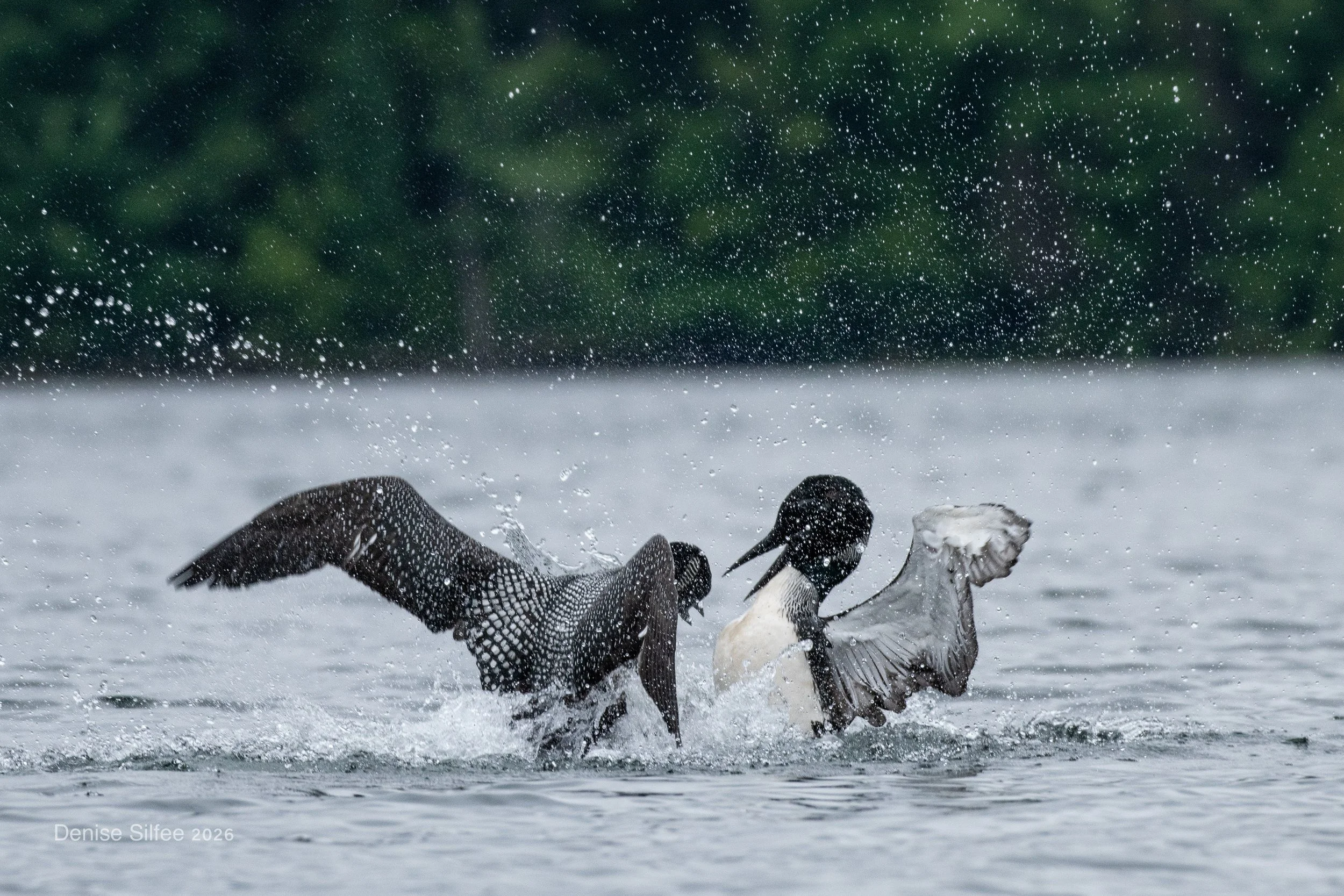
Loons are fiercely territorial during the nesting season, and will fight each other to the death to defend their territory. Photo by Denise Silfee
With these two loons, it was apparent that circle dancing wasn’t going to be enough. After an hour, the tension that had been building broke into a full blown fight. One loon clamped onto the other’s beak and they rose together almost like they were standing above the water and began beating each other with their wings, each refusing to let go. It was hard to watch, but I learned later that while fighting between loons is common, it is not an interaction many get to witness. I felt lucky to be in that spot on earth at the right time to see nature at its sharpest.
On my way out that day, after losing sight of the fast paced battle, out of the corner of my eye, I caught Shyguy peeping over at me as he slid away. He wasn’t the one with the mate after all, but I guess his secluded nature kept him out of the drama for today at least.

Eden Wondra observes the loons on “Lake Whatsit” and waits to see what happens next. Photo by Denise Silfee
The next week as I returned to check on the territories, I had no idea what to expect. I went to the North Bay first - nothing. It had returned to the silent bay it was a few weeks earlier. And then I heard yodeling and tremolo calls, both forms of territorial communication, from the opposite end of the lake and I paddled as fast as I could to investigate. I found two ruffled loons, as if they had recently left a battle scene. These two were in the middle of the lake so it seems no clear pair has yet won over a territory.
I did, however, find another shy friend with my Shyguy just as I was pulling up to the boat launch and thought, “Maybe I should turn my eyes to them instead.”
Who knows how the drama will unfold this summer on Lake Whatsit! But I look forward to finding what nature and time will reveal.